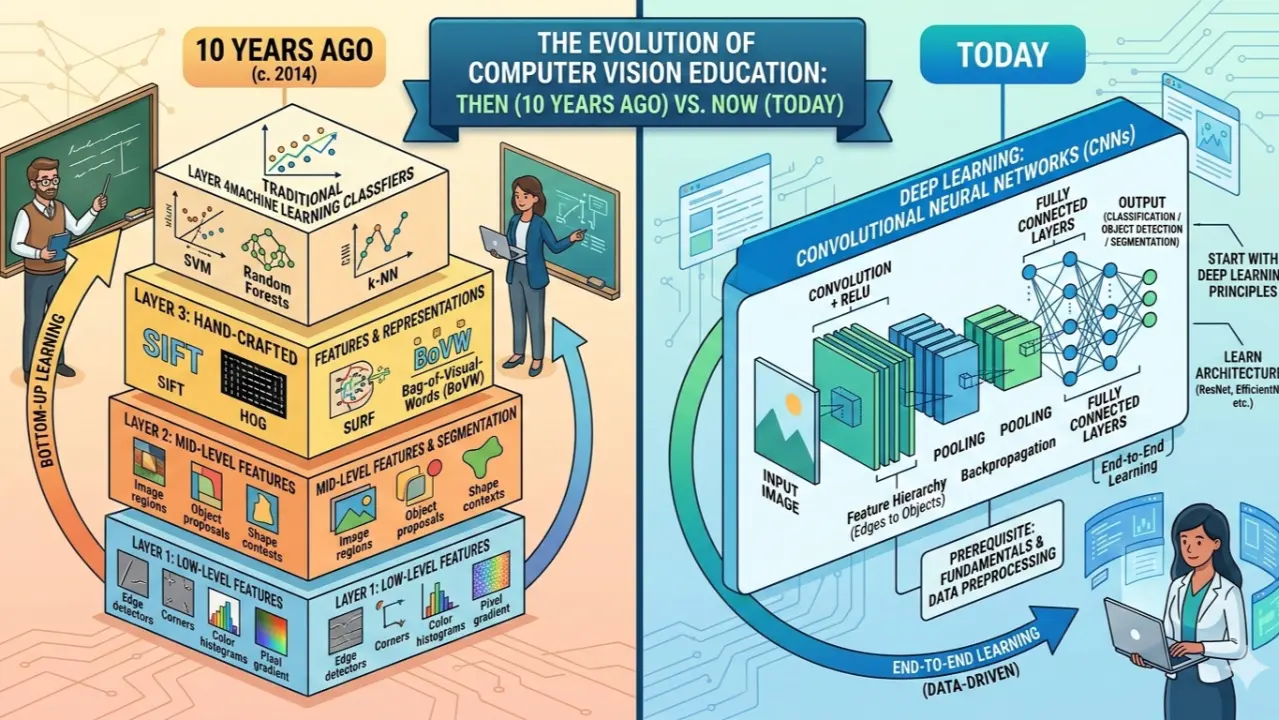
We’ve been reflecting on how rapidly the landscape of Computer Vision (CV) education has changed.
Then (Classic Era): We followed and taught a bottom-up approach, learning the mathematics behind handcrafted features such as edges, SIFT/SURF/HOG, and color histograms, which were then fed into classifiers like SVM or Random Forests. This process was labor-intensive but built a deep understanding of image structure and spatial relationships.
Today (Deep Learning Era): Professors often begin directly with CNNs, where features are learned automatically rather than engineered, which can leave gaps in students’ foundational understanding. Modern architectures such as ResNet and EfficientNet are trained end-to-end on large datasets, achieving state-of-the-art results and enabling faster development.
And here is where my concern lies:
While the modern approach is vastly more efficient and produces impressive results, I worry that we are creating a generation of CV specialists who might be “blind” to basic knowledge.
If the majority of professors and curriculum designers choose to approach Computer Vision solely through the lens of Machine Learning and Deep Learning, are we neglecting essential building blocks?
We risk producing engineers who can train a state-of-the-art classifier but might struggle to debug:
- The data is scarce. We can’t always count on Big Data to “solve” the problem. Hand-crafted, domain-specific features can be crucial in low-data regimes.
- The model fails. A graduate who understands HOG or edge gradients can debug. They can analyze the input image and see why the network is failing based on image structure. They have intuition. A graduate who only understands neural architectures only knows how to adjust hyper-parameters or add another layer.
- Efficiency matters. In edge and real-time systems, a small, elegant classical CV pre-processing block can be orders of magnitude more efficient than a full CNN layer doing the same job. You can’t build an efficient system if you don’t know all the tools.
- We need explainability. Classical methods are white-box; deep learning is often a black-box. Sometimes we need to be able to explain exactly why a system made a prediction.
The Solution?
This is not a call to go back to 2014. That would be absurd. But perhaps the ideal Computer Vision curriculum is not a choice between the two choices. Perhaps it’s a synthesis. We need to treat CNNs as a component of Computer Vision, not the whole discipline. A balanced curriculum should start with the fundamentals of image representation and classic features (Layers 1 and 2), and then build up to modern Deep Learning, showing how those basic components (like edge detection) are implicitly learned and operationalized by the CNN filters.
Are we producing scientists who truly understand vision, or are we just producing neural network mechanics?