The global race to hire AI engineers has never been more competitive. Whether you’re a Fortune 500 company integrating generative AI into your products, or a startup looking to build your first machine learning team, the challenge is the same: top AI talent is scarce, expensive, and nearly impossible to vet without deep domain expertise.
This guide covers everything you need to know about AI talent acquisition in 2025 — from what skills to look for in an AI developer, to how platforms like Divogue are transforming tech recruitment trends by giving companies instant access to pre-vetted AI engineers, computer vision specialists, LLM developers, and ML engineers.
| 🎯 Who This Is For: CTOs, Heads of Engineering, Startup Founders, and HR Leaders who need to hire AI developers, machine learning engineers, or build AI-powered teams — fast. |
1. Why Hiring AI Engineers Is Harder Than Any Other Tech Role
The demand for qualified AI engineers has outpaced supply by a staggering margin. According to LinkedIn’s 2024 Emerging Jobs Report, AI and machine learning roles have grown over 70% year-over-year — yet universities are producing a fraction of the graduates needed to fill these positions.
Here’s what makes AI recruitment uniquely challenging:
- Skillset breadth: Skillset breadth: A top AI engineer must combine Python, PyTorch, TensorFlow, cloud infrastructure (AWS, GCP, Azure), and domain-specific knowledge — few candidates tick every box.
- Speed of change: Speed of change: The AI field evolves so rapidly that engineers need to be continuous learners — a 2-year-old credential can already be outdated.
- Assessment difficulty: Assessment difficulty: Traditional coding interviews fail to evaluate AI model design, RAG architecture, fine-tuning, or computer vision performance.
- Remote competition: Remote competition: Your local market is competing globally — a talented ML engineer in Pakistan or Latin America can work for a Silicon Valley startup from day one.
| 📌 Divogue Insight: Divogue solves all four challenges by maintaining a live network of 350,000+ pre-vetted AI engineers globally, with domain-specific vetting across AI/ML, LLMs, RAG, Computer Vision, and Data Engineering. |
2. The Top Skills to Look For When You Hire AI Developers
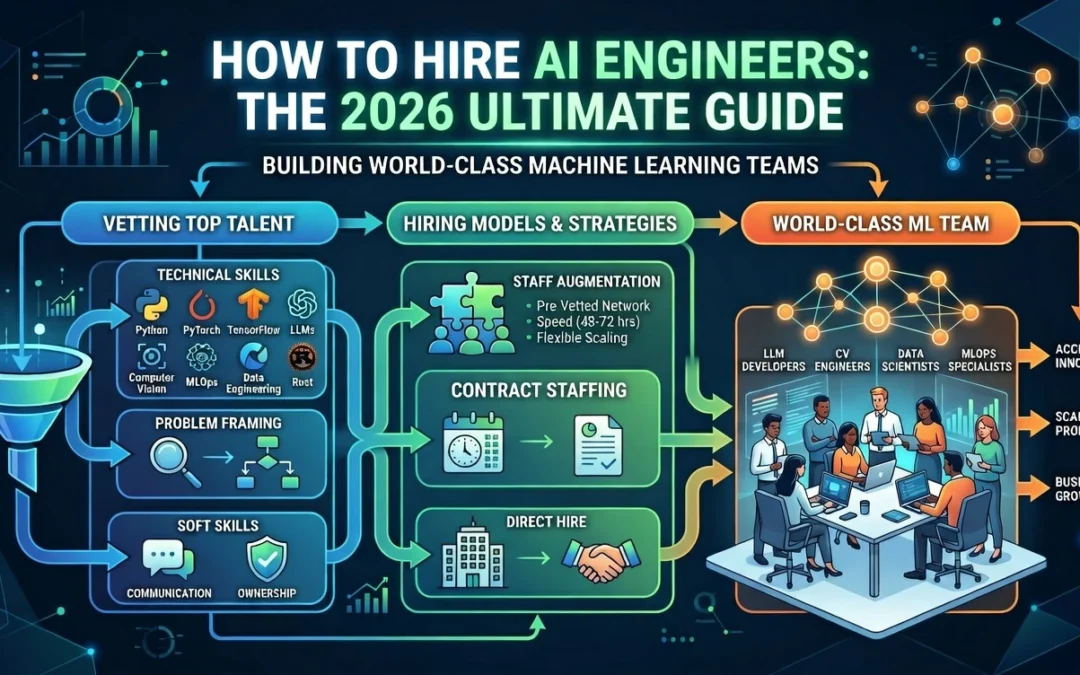
Before you post a job or engage a staffing agency, you need to know what to look for. The best AI developers in 2025 typically have expertise across multiple layers of the AI development stack:
Core Technical Skills
- Programming Languages: Python (primary), Rust, Julia, C++ for performance-critical AI components
- Frameworks: TensorFlow, PyTorch, Hugging Face Transformers, LangChain, LlamaIndex
- Cloud AI Services: AWS SageMaker, Google Vertex AI, Azure Machine Learning, Bedrock
- LLM Engineering: GPT-4, Claude, Mistral fine-tuning, prompt engineering, RLHF, RLAIF
- RAG (Retrieval-Augmented Generation): Vector databases, Pinecone, Weaviate, ChromaDB
- MLOps: Model deployment, monitoring, CI/CD for ML pipelines, Docker, Kubernetes
- Computer Vision: OpenCV, YOLO, Detectron2, real-time video analytics, object detection
- Data Engineering: Apache Spark, Kafka, dbt, SQL/NoSQL databases, Neo4j for graph AI
Soft Skills That Separate Good from Great AI Engineers
- Communication: Can they explain model trade-offs to non-technical stakeholders?
- Problem framing: Do they understand the business problem before reaching for an algorithm?
- Continuous learning: Are they up to date with the latest papers, models, and techniques?
- Ownership mentality: Will they take a feature from research to production without hand-holding?
3. AI Talent Acquisition Strategies That Actually Work in 2025
Most companies make one of three mistakes in AI talent acquisition: they post generic job descriptions, rely on outdated sourcing channels, or skip technical vetting entirely. Here’s what actually works:
Strategy 1 — Use a Pre-Vetted AI Engineer Network
The most efficient way to hire AI engineers fast is to tap into a network where candidates have already been screened for technical competency, communication, and reliability. Platforms like Divogue maintain vetted communities of senior AI developers — meaning you skip months of sourcing and get curated profiles within 48–72 hours.
Companies like Riskcast Solutions, BGO Software, and Science4Data rely on Divogue to hire AI developers who feel like extensions of their own teams — not external contractors.
Strategy 2 — Define Your Hiring Model Before You Search
One of the biggest mistakes in tech recruitment is searching for candidates before defining the engagement model. Ask yourself:
- Do you need a full-time AI developer or a contract ML engineer?
- Is this a long-term product build or a 3-month research sprint?
- Do you need on-site presence or is remote AI developer hiring acceptable?
- Are you open to offshore staffing to save 40–60% on engineering costs?
Divogue supports all engagement models — direct hire, contract staffing, Offshore Staffing, and Employer-of-Record (EoR) arrangements — so you’re never locked into a single approach.
Strategy 3 — Prioritize Domain Expertise Over Generic ML Skills
Not all AI engineers are interchangeable. A computer vision engineer optimizing real-time video inference has a very different profile than an NLP engineer building a RAG-based enterprise chatbot. Define your domain clearly:
- Computer Vision Engineers — object detection, video analytics, image segmentation
- NLP / LLM Engineers — language model fine-tuning, RAG, embeddings, agents
- ML Platform Engineers — MLOps, model serving, infrastructure
- AI Product Engineers — full-stack with AI integration (React + Python + LLM APIs)
- Data Scientists — statistical modeling, A/B testing, experimentation
4. Tech Recruitment Trends Shaping AI Hiring in 2025–2026
Understanding where tech recruitment is heading helps you compete for talent more effectively. Here are the five biggest trends reshaping how companies hire AI engineers:
Trend 1 — Skills-Based Hiring Over Credentials
Top companies are dropping degree requirements for AI roles. What matters now: GitHub portfolios, Kaggle competition results, published models on Hugging Face, and demonstrated ability to ship AI features to production. Divogue’s vetting process is 100% skills-based — no resume gatekeeping.
Trend 2 — Remote-First AI Staffing Goes Mainstream
The best AI talent is globally distributed. Companies that restrict hiring to a single geography are competing for a tiny fraction of the available talent pool. Divogue’s network spans North America, Latin America, Europe, and Asia-Pacific — giving clients access to world-class remote AI developers regardless of location.
Trend 3 — Speed of Hire Is a Competitive Advantage
When a top AI engineer is available, they receive multiple offers within days. Slow hiring processes mean missed opportunities. Divogue’s pre-vetted model cuts time-to-hire by up to 60% — with curated candidate profiles delivered in 48 hours and interviews scheduled same-week.
Trend 4 — AI Staff Augmentation Becomes the Default Model
Rather than building entire AI departments from scratch, leading companies are augmenting existing teams with specialized AI engineers on demand. This flexible model — often called AI staff augmentation — allows companies to scale AI capacity up or down based on project needs without long-term headcount commitments.
Trend 5 — Continuous Vetting Replaces One-Time Screening
The best platforms don’t just vet engineers once. Divogue’s community includes ongoing performance tracking, client feedback loops, and regular re-assessment — ensuring the quality of its AI developer network continuously improves.
5. How to Evaluate an AI Engineer: A Practical Interview Framework
Most technical interviews for AI engineers fail because they test generic coding ability — not AI-specific reasoning. Here’s a better framework:
Stage 1 — Problem Framing (30 min)
Give the candidate a real business problem (e.g., ‘We have 10,000 customer support tickets per day — how would you build an AI system to auto-categorize and resolve them?’). Evaluate:
- Do they ask clarifying questions before jumping to a solution?
- Can they reason about latency, accuracy, and cost trade-offs?
- Do they consider data quality, bias, and edge cases?
Stage 2 — Technical Deep-Dive (60 min)
Ask them to walk through a recent project they built end-to-end. Probe:
- What model architecture did they choose and why?
- How did they handle training data curation and labeling?
- What evaluation metrics did they use and how did they interpret them?
- How did they deploy the model and monitor it in production?
Stage 3 — Live Coding or Whiteboard (45 min)
Focus on AI-specific tasks: implementing a simple transformer attention mechanism, designing a RAG pipeline, or debugging a training loop. Avoid generic LeetCode-style problems unless the role specifically requires algorithmic optimization.
Stage 4 — Culture and Communication Fit (30 min)
Remote AI engineers must be exceptional communicators. Ask: How do you handle disagreements with product managers about model scope? How do you explain model uncertainty to stakeholders? Have them write a brief technical summary of a complex concept for a non-technical audience.
| ✅ Divogue Advantage: Divogue conducts all four stages of this evaluation before you ever see a candidate profile. Every engineer in the Divogue network has passed domain-specific technical screening, communication assessment, and reference checks — so your time is spent on final interviews, not filtering. |
6. Hire Remote AI Engineers: The Cost and Quality Equation
One of the most common objections to remote AI developer hiring is quality uncertainty. The data tells a different story:
Companies that hire remote AI engineers through vetted platforms report:
- 40–60% cost savings vs. equivalent US/UK-based hires
- Faster time-to-productivity due to pre-screened skills alignment
- Higher retention rates — remote AI engineers hired through staffing partners average 2.4x longer engagement than direct hires
- Access to niche skills (e.g., Neo4j graph AI, Rust-based ML inference) unavailable in local markets
Divogue’s talent network spans Asia-Pacific and Latin America — regions that have produced extraordinary AI engineering talent, particularly in Python, AWS, RAG architectures, and Computer Vision. Clients like 3dThinks and Virtulab have run multi-year engagements with Divogue engineers who consistently deliver at the level of senior engineers in top US markets.
7. AI Staffing Agency vs. Freelance Marketplace vs. In-House Recruiting
If you’re weighing your options for how to hire AI developers, here’s an honest comparison:
| Criteria | AI Staffing Agency(e.g. Divogue) | Freelance Marketplace | In-House Recruiting |
|---|---|---|---|
| Time to Hire | 48–72 hours | 1–2 weeks | 4–12 weeks |
| Vetting Quality | Deep AI-specific | Self-reported | Varies widely |
| Cost vs. US Rates | 40–60% savings | Variable | High overhead |
| Flexibility | High (all models) | Medium | Low |
| Ongoing Support | Yes (PM oversight) | None | Internal HR |
| Risk | Low (trial periods) | Medium-high | High (bad hires) |
The verdict: For companies that need to hire AI engineers fast, with high confidence in quality and flexibility, an AI staffing agency with a pre-vetted network is the clear winner — particularly for remote or offshore engagements.
8. Why Companies Choose Divogue for AI Engineer Recruitment
Divogue is not a traditional staffing agency. It is an AI-powered, vetted engineering community built specifically for companies that need elite AI talent — fast and reliably.
What Makes Divogue Different
- Scale: 350,000+ pre-vetted engineers across AI/ML, LLMs, Computer Vision, RAG, Data Engineering, and Full-Stack AI
- Deep Vetting: Domain-specific vetting — not generic coding tests, but real AI system design evaluation
- Flexibility: All engagement models — direct hire, contract, offshore staffing, EoR, fractional leadership
- Speed: 48-hour candidate delivery — curated profiles matched to your exact technical requirements
- Zero Risk: 2-week risk-free trial — test the engineer before you commit
- Continuous Support: Ongoing quality assurance — Divogue provides PM oversight throughout the engagement
- Cost Efficiency: 40–60% cost reduction vs. equivalent US/UK hires — without compromising quality
Who Trusts Divogue
Divogue’s clients include global enterprises and fast-moving startups: Riskcast Solutions, BGO Software, ATG Entertainment, Science4Data, Qpharma Inc., Netiks Solutions, and Commerce Blitz — companies that have embedded Divogue engineers as long-term team members, not temporary contractors.
“Divogue has been an outstanding technology partner… consistently delivering high-quality work across both front-end and back-end. The team was reliable, skilled, and always proactive in solving challenges.”
— David Cummins, CEO, Virtulab
9. High-Volume SEO Keywords: What Companies Are Searching for Right Now
If you’re a company researching how to build your AI team, you’re likely searching for terms like:
- hire AI engineers
- AI talent acquisition strategies 2025
- tech recruitment trends AI
- machine learning engineer for hire
- hire remote AI developers
- computer vision engineer recruitment
- AI staff augmentation
- pre-vetted AI developers
- AI recruitment agency
- offshore AI development team
- hire LLM engineers
- RAG developer for hire
- how to hire machine learning engineer
- AI staffing agency
- AI developer staffing platform
Divogue is the answer to every one of these queries. Whether you need a single senior ML engineer or an entire AI development team, Divogue’s vetted network and agile hiring process deliver results in days — not months.
Ready to Hire Your Next AI Engineer?
Stop spending months on sourcing, screening, and interviewing candidates who don’t make it past the first technical round. Divogue gives you instant access to the world’s best pre-vetted AI engineers — with the flexibility, speed, and quality guarantees that modern tech companies demand.
Get started today: www.divogue.net | Schedule a call with an AI Talent Specialist
| 🚀 Divogue’s Promise: We’ll deliver curated, pre-vetted AI engineer profiles within 48 hours of your brief. Your first 2 weeks are risk-free. No long-term contracts required. |
About Divogue
Divogue is an AI-powered vetted community of expert AI engineers, backed by an agile hiring process. Fortune 500 companies and high-growth startups rely on Divogue to build exceptional AI-powered products with elite, pre-screened engineering talent. Divogue’s network spans 350,000+ engineers globally, with specializations in AI/ML, LLMs, Computer Vision, RAG, Data Engineering, and Full-Stack AI development.
Website: www.divogue.net | Email: info@divogue.net | Phone: +1 818-693-2325
30 N Gould St, STE 4000, Sheridan, WY 82801 | LinkedIn: Divogue | Instagram: @divogue1