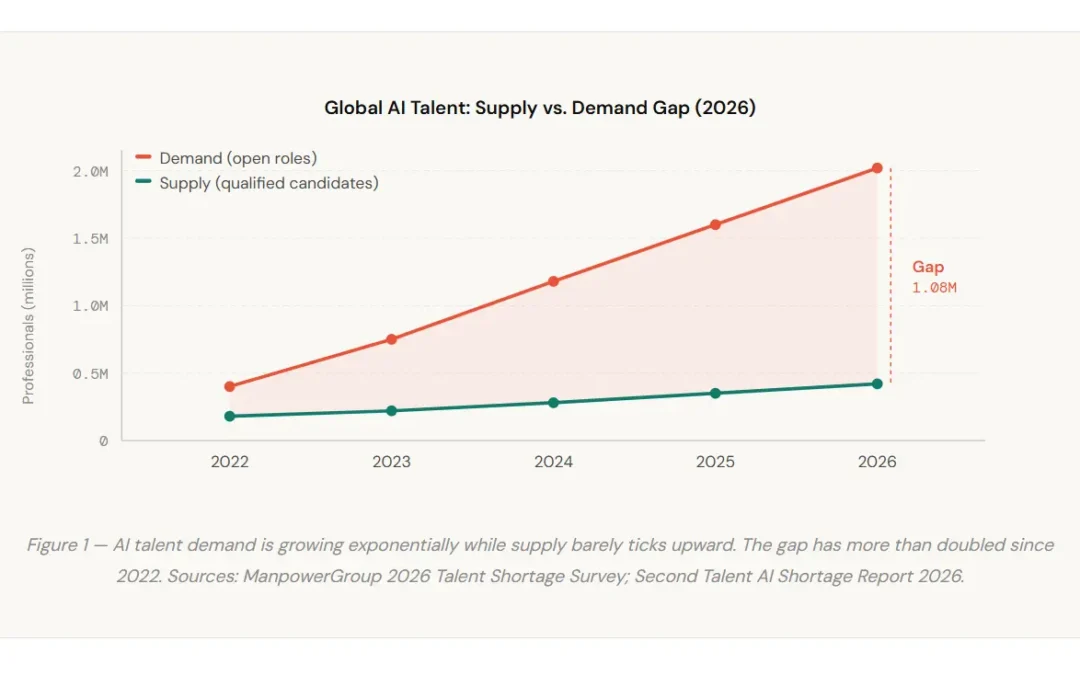
AI talent demand now outpaces supply by 3.2:1 globally. The gap is structural, growing, and costing businesses trillions. Here’s the full breakdown — and the strategies actually working right now.
Open your engineering job board. Count the days those AI roles have been sitting empty. Feel that familiar knot? You’re not alone — and you’re not imagining that it’s getting worse.
The AI talent shortage of 2026 isn’t a temporary blip caused by post-pandemic hiring freezes or tech layoffs. It is structural, widening from both ends, and showing no signs of natural correction. The companies building AI products right now are competing for a pool of talent that simply isn’t large enough to go around.
This article breaks down why the gap exists, which roles are most affected, what it’s costing businesses, and — most importantly — what’s actually working for companies that need to hire AI engineers today.
The Crisis in Numbers
Let’s start with the scale of the problem. These aren’t rounding errors or projections — these are the numbers defining the 2026 hiring landscape.
Why the Gap Keeps Widening
This isn’t simply a case of demand spiking faster than universities can graduate students. The AI talent gap is widening from both ends simultaneously — and that makes it uniquely resistant to the usual fixes.
The pipeline problem
Just 205 AI PhDs were awarded in the United States in 2022. Over half of all AI master’s and doctoral degrees earned in the U.S. were earned by non-citizens — making the talent pipeline structurally dependent on immigration policy in ways most hiring plans don’t account for. Academic programs produce generalists; industry demands specialists. And the professionals best positioned to train the next generation are increasingly being pulled into high-paying private sector roles.
AI is automating the entry-level roles that build senior talent
Here’s the compounding problem most shortage analyses miss: AI tools like GitHub Copilot and Claude Code are automating the boilerplate, documentation, and scaffolding tasks that used to be the domain of junior engineers. Entry-level positions in tech have effectively declined — which means there are fewer junior engineers developing into the senior specialists organizations will need in three to five years. The gap is being fed from the bottom, not just the top.
The 2026 production shift
The 2023–2025 window was AI experimentation. In 2026, companies are moving AI to production — and that requires an entirely different skill set. GPU orchestration, model serving, MLOps, LLM integration into existing products, monitoring for model drift: these are production engineering problems, not data science problems. AI-related job postings have grown counter-cyclically even during broader tech layoffs, because this demand is additive, not substitutional.
The Five Most In-Demand AI Roles of 2026
The AI job market isn’t monolithic. Demand is concentrated in specific profiles — and understanding which roles are most scarce helps prioritize where to focus hiring effort.
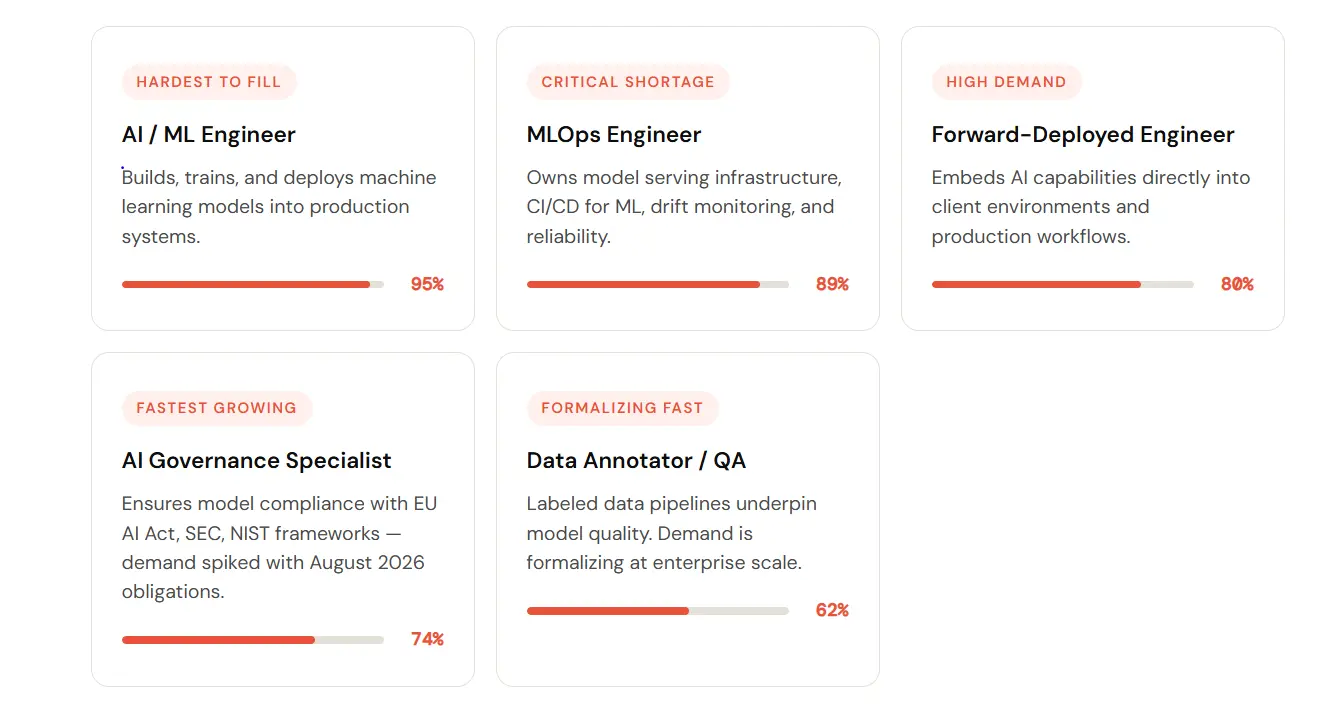
The demand for AI/ML Engineer roles has seen a 143.2% year-over-year increase, with a median annual salary now at $156,998. The focus has shifted decisively from general data science toward production and governance profiles — reflecting where most enterprise AI programs actually are in their roadmap today.
Supply vs. Demand: A Visual Breakdown
The following diagrams illustrate why conventional hiring pipelines are failing — and where the structural mismatch is most severe.
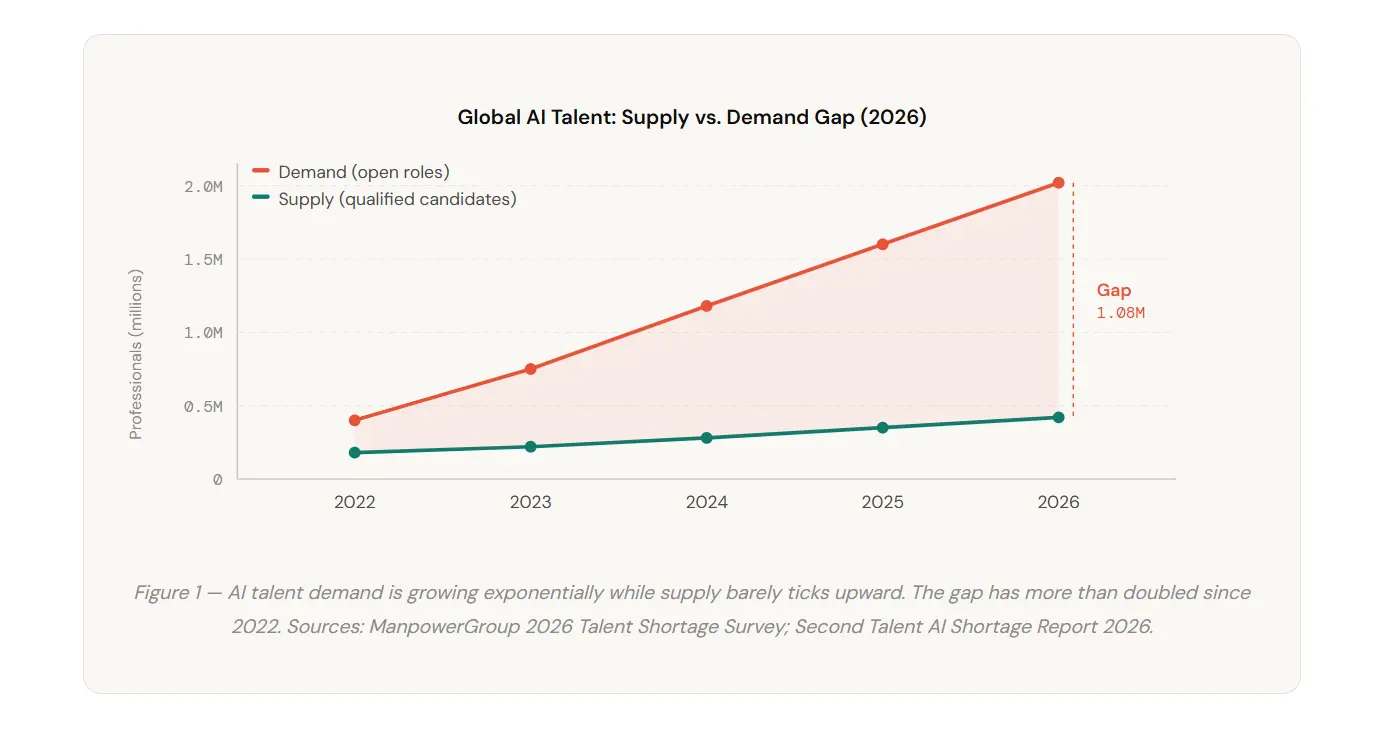
The chart above illustrates the core problem: supply of qualified AI talent is growing slowly and linearly. Demand is growing exponentially. Every conventional hiring lever — posting more jobs, increasing compensation, requiring fewer credentials — is pulling from the same undersupplied pool.

What the Shortage Is Costing Businesses
The financial impact of the AI talent shortage goes far beyond salaries. IDC predicts that the IT talent shortage will cost organizations worldwide $5.5 trillion in losses by 2026 — a figure that captures delayed product launches, lost revenue from slower innovation, and the cascading cost of burnout among the senior engineers who remain.
Here’s how the costs stack up beyond direct salaries:
- 66 days average time-to-fill for a senior AI role — 50% longer than non-technical positions, with all the productivity loss that entails.
- 87.5% of tech leaders in a 2026 Lemon.io survey rated hiring skilled AI engineers as “difficult” or worse. Not one rated it “easy.”
- $20K+ lost on failed technical assessments is just the first domino — unqualified hires can derail entire project timelines.
- Salary inflation of 67% above traditional software roles, with 38% year-over-year growth across all experience levels — plus signing bonuses, equity, and specialized perks to compete.
- Companies successfully addressing the gap achieve 2.3× faster AI adoption and 67% higher AI ROI compared to those struggling with talent gaps (BCG research).
Three Strategies Companies Are Using to Hire
Organizations gaining ground on the AI talent shortage aren’t just posting more jobs. They’ve fundamentally rethought how AI teams are structured, sourced, and scaled. Three approaches are emerging as the most effective combinations.
1. Lean core + distributed senior talent
High-growth companies are keeping a small onshore team for architecture and stakeholder management, then sourcing senior AI engineers globally via staff augmentation. This unlocks talent pools in Eastern Europe, LatAm, and Southeast Asia — regions building strong AI engineering communities.
2. AI staff augmentation (project-based)
AI development scales in phases — model development, production deployment, governance. Flexible staffing tied to roadmap phases is outperforming steady headcount. Companies build around a core of permanent senior engineers and augment for each phase.
3. Skills-first hiring with pre-vetting
The 2026 hiring market is skills-first. Employers are abandoning degree-based screening for validated, job-ready skills. Pre-vetted talent marketplaces that do the technical screening externally compress time-to-hire from 66 days to days. The fastest way to act on this is to hire pre-vetted AI engineers through a partner that handles the screening for you.
In-House Hiring vs. Divogue: A Comparison
For companies evaluating how to close their AI engineering gap, the decision often comes down to a direct comparison between building a traditional recruitment pipeline and using a pre-vetted talent partner. Here’s how those two approaches stack up across the metrics that matter.
| Metric | Traditional In-House Hiring | Divogue |
|---|---|---|
| Time to first interview | 2–6 weeks (sourcing, screening) | Within 24–48 hours |
| Time to hire | 66 days average for senior AI roles | 7–14 days |
| Technical vetting | Done by your team (bandwidth cost) | Pre-screened, top 1% verified |
| Salary costs | US market rates + benefits ($180–250K+ total comp) | Up to 50% lower via global talent |
| Talent pool size | Local or national market only | Global pre-vetted network |
| Flexibility | Permanent hires, fixed headcount | Scale up/down per roadmap phase |
| Compliance & payroll | You handle internationally | Managed end-to-end |
| Failed hire risk | High — avg $20K+ per assessment failure | Replacement guarantee included |
| Roles supported | Whatever your recruiter can reach | AI/ML, MLOps, LLM, FDE, Data Eng |
The comparison above reflects a simple reality: when the talent pool is structurally undersupplied, the companies that win are the ones that access that pool faster, with less friction, at a broader geographic scope than their competitors.
What to Do Right Now
If you’re currently trying to hire AI engineers, the most expensive thing you can do is wait for the market to normalize. The structural drivers of this shortage — thin PhD pipelines, automation of entry-level roles, and the shift from experimentation to production AI — are multi-year forces. Here’s where to start:
- Stop competing only in your local market. The uniformity of programming languages and AI tooling enables global collaboration in ways that weren’t true five years ago. Expand your sourcing geography before your competitors do.
- Move before you’re in a delivery crunch. Reactive hiring during a project crisis is expensive, slow, and results in hires you wouldn’t make with time to be selective. Build the pipeline now.
- Map roles to your AI roadmap phases. Not every AI role needs to be permanent. Identify where staff augmentation gives you speed without overcommitting headcount.
- Define which roles must be onshore. Backend, ML, MLOps, QA automation, and data engineering all integrate smoothly into distributed workflows. Roles with heavy in-person regulatory requirements need more governance design — but fewer roles meet that bar than most hiring plans assume.
- Track the leading indicators early. Time-to-hire, offer acceptance rate, senior/junior ratio, and cost per shipped AI feature are all signals that the talent shortage is compressing your delivery capacity. Don’t wait for a missed deadline to act.
Hire Pre-Vetted AI Engineers in 24 Hours
Divogue connects you with the top 1% of AI/ML engineers globally — fully vetted, production-ready, and assembled for your team in a day. Up to 50% lower cost than local hiring.