AGENTIC AI · 2026 TREND REPORT
By Divogue Editorial Team · April 2026 · 12 min read · AI Engineering
Gartner predicts 40% of enterprise applications will embed task-specific AI agents by 2026 — up from under 5% just a year ago. If your engineering team hasn’t started thinking about agentic AI, you’re already behind.
| 40%
of enterprise apps will use AI agents by 2026 |
143%
YoY growth in AI Engineer job postings (LinkedIn) |
$245K
Median total comp for AI engineers at top tech firms |
1. What Is an AI Agent, Really?
DEFINITION
An AI agent is an autonomous software system that perceives its environment, reasons about a goal, takes multi-step actions using tools and APIs, and adapts its behavior based on feedback — all with minimal human intervention.
Think of a traditional AI chatbot as a vending machine: you press a button, it dispenses a response. An AI agent, by contrast, is closer to a junior employee — one that can receive a high-level objective, break it into tasks, execute those tasks across multiple systems, handle errors independently, and report back when done.
The shift from static AI to agentic AI is the most consequential change in software engineering since the cloud. It’s not just about smarter outputs — it’s about AI systems that act, not just answer.
The Perception → Reason → Act Loop
At its core, every AI agent runs a continuous loop:
- Perceive: Ingest the current state — user prompt, tool outputs, memory, environment signals
- Reason: Use an LLM to plan the next action, select a tool, or decide to ask for clarification
- Act: Execute the chosen action — run code, call an API, query a database, spawn a sub-agent
- Evaluate: Assess whether the action succeeded and whether the overall goal is closer to completion
- Repeat: Loop until the goal is achieved, a stopping condition is met, or human input is needed
Key inputs an AI agent processes simultaneously
- User goal / natural language objective
- Current environment state (APIs, files, databases)
- Outputs from previous tool calls
- Short-term and long-term memory store
Actions an AI agent can take autonomously
- Write, run, and debug code in a sandboxed environment
- Search the web and retrieve real-time information
- Read from and write to APIs, databases, and file systems
- Spawn specialist sub-agents and delegate parallel tasks
2. Agentic AI vs. Traditional LLMs: What’s the Difference?
Most people’s mental model of AI is still stuck at the chatbot level — ask a question, get an answer. Agentic AI is a fundamentally different paradigm.
| Capability | Traditional LLM | AI Agent |
| Multi-step task execution | No | Yes |
| Tool & API usage | Limited | Yes — natively |
| Memory across sessions | No | Yes |
| Self-correction on failure | No | Yes |
| Spawns sub-tasks / agents | No | Yes |
| Operates autonomously over hours | No | Yes |
| Learns from its own actions | No | Emerging |
“AI agents aren’t just smarter chatbots. They’re a new class of software — closer to autonomous employees than to search engines.”
3. How Multi-Agent Systems Work
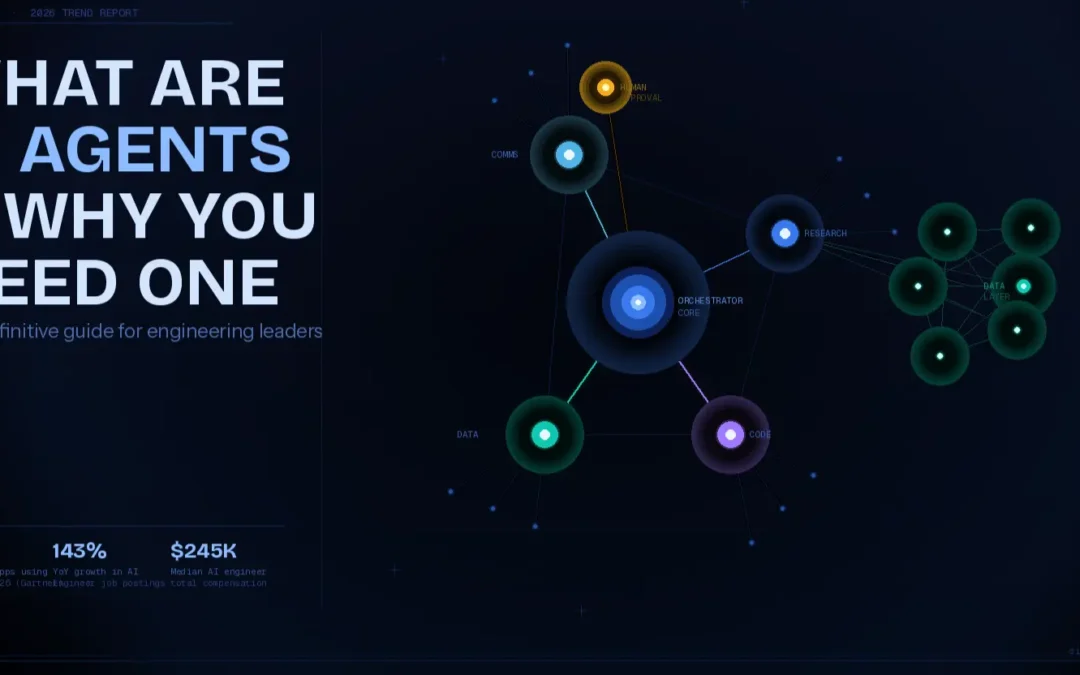
The real power of agentic AI emerges when you combine multiple specialized agents into an orchestrated system — each handling a specific domain, coordinated by an orchestrator agent.
Orchestrator + Specialist Pattern
A common production architecture looks like this:
Orchestrator Agent (the coordinator)
Receives the high-level goal from the user or upstream system.
Decomposes it into subtasks and delegates to specialist agents.
Monitors progress, handles failures, and synthesizes final output.
Applies guardrails: budget limits, timeouts, approval gates.
Specialist Agents (run in parallel)
Research Agent — Web search, document retrieval, RAG pipelines
Code Agent — Write, test, and debug code across languages
Data Agent — Analyse datasets, generate visualisations, surface insights
Comms Agent — Draft emails, Slack messages, reports, and notifications
The orchestrator collects all specialist outputs, resolves conflicts, and synthesizes a final deliverable. If one specialist fails, the orchestrator can retry with a different approach or flag for human review — without the entire workflow breaking.
4. Top Use Cases: Where AI Agents Are Being Deployed Right Now
Across industries, AI agents are moving from pilots to core infrastructure. Here are the highest-impact deployments in 2026.
| Use Case | What AI Agents Do |
| Autonomous Software Development | Write code, run tests, debug, open pull requests — end-to-end sprint tickets |
| Automated Data Analysis | Ingest datasets, run statistical tests, produce charts and written summaries |
| Sales & Marketing Automation | Research leads, personalise outreach, update CRMs, surface pipeline insights |
| Security & Monitoring | Scan logs, correlate threat signals, triage alerts, draft incident reports 24/7 |
| Customer Support at Scale | Resolve complex tickets via knowledge bases, order systems, and smart escalation |
| Research & Knowledge Work | Synthesise literature, extract structured data from papers, accelerate R&D cycles |
5. The RAG vs. Fine-Tuning vs. Agents Triangle
A common question from engineering leaders: “Do we need RAG, fine-tuning, or agents?” The honest answer is that they solve different problems — and in 2026, production-grade AI systems typically use all three in tandem.
| Criteria | RAG | Fine-Tuning | AI Agents |
| Best for | Q&A, search, citations | Domain style & expertise | Complex, multi-step tasks |
| Real-time data | Yes | No | Yes |
| Requires retraining | No | Yes | No |
| Tool use | Limited | No | Yes — core feature |
| Self-correcting | No | No | Yes |
| Cost to update | Low | High | Low |
Think of it this way: fine-tuning gives the agent domain knowledge and communication style; RAG gives it access to current proprietary data; the agent layer gives it the ability to act on that knowledge autonomously and repeatedly.
6. How to Hire an AI Agent Engineer in 2026
With AI Engineer now ranked the #1 fastest-growing job title on LinkedIn, finding the right talent — one who can actually ship production-grade agentic systems — requires knowing exactly what skills to look for.
Core Technical Skills to Assess
| Technical Skill | Why It Matters |
| LLM API integration | Core capability — must know OpenAI, Anthropic, Gemini, open-source models |
| RAG pipeline design | Grounds agents in your proprietary data without constant retraining |
| Agent frameworks | LangChain, LlamaIndex, AutoGen, CrewAI — practical production tools |
| Prompt engineering | Determines reliability of agent reasoning and structured output quality |
| Tool use & function calling | Connects the agent to real systems — APIs, databases, file systems |
| MLOps & monitoring | Without observability, production agents are a black box |
| Memory systems | Short-term context, long-term storage, episodic recall design |
| Multi-agent orchestration | Designing communication protocols between specialist agents |
| Python + TypeScript | Python mandatory; TypeScript valued for full-stack agent systems |
| AI safety & guardrails | Hallucination mitigation, output validation, scoped permissions |
Red Flags to Watch For
Many candidates claim “AI experience” from wrapping the OpenAI API in a chatbot. True AI agent engineers have built systems that run autonomously, handle failure gracefully, maintain state across sessions, and integrate with real external tools.
Ask for GitHub links, production case studies, and walk them through a live debugging scenario. The best candidates will immediately talk about observability, retry logic, and cost controls — not just model selection.
“The difference between a developer who can use AI and an AI agent engineer is the same as the difference between someone who can drive and someone who can build a car.”
7. Challenges in Building Agentic AI Systems
For all their promise, AI agents introduce a new class of engineering challenges that teams need to be prepared for.
| Challenge | What It Means | How Top Teams Handle It |
| Hallucination in action chains | Agents can fabricate tool outputs or make confident wrong decisions | Output validation layers, grounding with RAG, human-in-the-loop checkpoints |
| Infinite loops / runaway agents | Agents can get stuck re-trying failed steps indefinitely | Hard timeouts, step counters, circuit breakers in orchestration logic |
| Cost management | Multi-step agents can burn through LLM tokens rapidly | Caching, smaller models for subtasks, token budget enforcement |
| Evaluation difficulty | Traditional test suites don’t capture agent behaviour well | Trajectory evaluation, LLM-as-judge scoring, success rate benchmarking |
| Security & prompt injection | Malicious input can hijack an agent’s action chain | Input sanitisation, scoped permissions, sandboxed execution environments |
8. How Divogue Helps You Build Your AI Agent Team
At Divogue, we’ve spent years building a global network of pre-vetted AI and ML engineers — and in 2026, our focus has sharpened on agentic AI specialists. When you work with us, you get access to engineers who have shipped production agent systems, not just experimented in Jupyter notebooks.
Our vetting process goes deep: we assess LLM integration skills, RAG pipeline design, agent framework experience, and — critically — the ability to design safe, observable, and cost-efficient systems. We reject over 97% of applicants. You meet only the top 1%.
We can assemble an AI agent team in as little as 24 hours, with engineers across North America, Europe, Latin America, and Asia-Pacific ready to integrate with your existing team and stack.
Ready to Add an AI Agent Engineer to Your Team?
We’ll match you with a pre-vetted AI agent specialist within 24 hours. No recruiter delays, no sourcing guesswork. Visit divogue.net to get started.
Tags: AI Agents · Agentic AI · Hire AI Engineer · LLM · RAG · Multi-Agent Systems · AI Staff Augmentation · AI Engineering 2026 · Remote AI Developers · LangChain · AutoGen · CrewAI