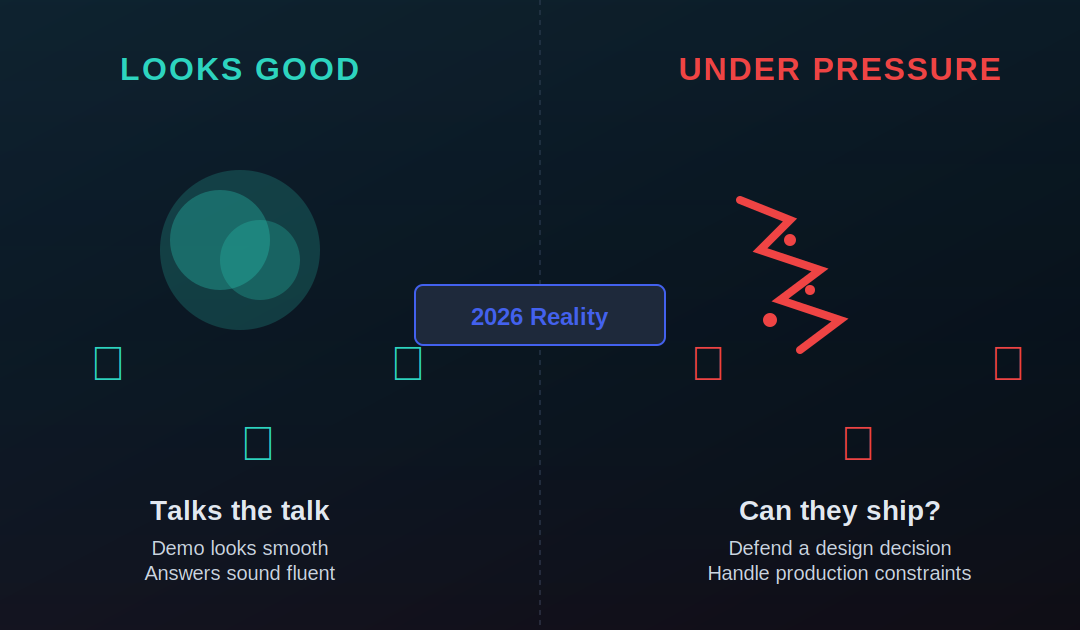
Here is an uncomfortable truth about hiring AI engineers in 2026: the candidate sitting across from you can probably look brilliant without being brilliant.
AI coding assistants have made it easy for anyone to produce clean, confident-looking code on demand. Roughly 84% of developers now use or plan to use AI coding tools, but only about 29% say they trust the output those tools produce. That gap is the whole problem. When a take-home assignment can be finished by Cursor or Claude Code in minutes, a polished submission no longer tells you whether the person can actually engineer.
So how do you vet an AI engineer when the usual signals have stopped working? This is the playbook we use at Divogue to screen AI-fluent engineers before we ever put them in front of a client. Steal all of it.
Why Old-School Vetting Is Broken
For years, the standard screen was simple: a resume scan, a technical quiz, a take-home project, and a culture chat. That pipeline assumed the candidate’s output reflected the candidate’s ability. In 2026, that assumption is dead.
Consider what changed. Studies suggest as much as 41% of new code is now AI-generated, and roughly a quarter of production code at AI-heavy teams is written by assistants. That is great for shipping speed. It is terrible for hiring signal, because a weak engineer armed with good tools produces work that is almost indistinguishable from a strong engineer’s first draft.
Worse, the polish hides real risk. One analysis found that around 48% of AI-generated code snippets contained security vulnerabilities. A controlled study by METR even found experienced developers were 19% slower on familiar codebases when leaning on AI, while believing they had gotten faster. In other words: the tools create an illusion of competence on both sides of the table.
If your screening still rewards “did they produce working code,” you are now optimizing for the exact thing AI commoditized.
What You’re Actually Screening For Now
The job has shifted from “can you write code” to “can you judge code, direct tools, and own outcomes.” When we vet an AI engineer, we are really testing four things:
1. Judgment over output
Can they tell good AI output from confident garbage? The most valuable engineer in 2026 is the one who catches the hallucinated API, the subtle race condition, and the insecure default that the model happily generated.
2. Problem framing
Can they break a messy business problem into something a model can actually help with? Prompting is the easy part. Knowing what to ask, and what not to delegate, is the skill.
3. Debugging the machine’s work
Reading and fixing code you didn’t write, fast, is now a core daily task. AI writes the first draft; the engineer is the reviewer, the editor, and the last line of defense before production.
4. Ownership
When the AI gets it wrong and it ships, does the candidate take responsibility, or blame the tool? This is a values test as much as a skills test.
The Divogue 5-Stage Vetting Process
Here is the actual sequence, step by step. You can run a lighter version of this in a single afternoon.
Stage 1: The resume reality check (10 minutes)
Ignore the buzzword soup. “LLMs, RAG, MLOps, agents” on a resume means nothing on its own now. Look instead for specifics: which model, which problem, what the measurable result was, and what broke. A real engineer can name the trade-off they made. A keyword stuffer cannot. Flag any resume that lists ten frameworks but explains zero decisions.
Stage 2: The live reasoning call (30 minutes)
This is the most important stage, and it is deliberately not a coding test. Walk through a real problem out loud. Ask: “Walk me through how you’d approach building a RAG system for customer support tickets.” You are not grading the answer. You are listening for how they think, what questions they ask back, and where they say “I don’t know, here’s how I’d find out.” AI can’t fake a real-time conversation about trade-offs.
Stage 3: The “review this, don’t write it” test (45 minutes)
Flip the take-home on its head. Instead of asking them to write code, hand them a working-but-flawed piece of AI-generated code and ask them to review it. Plant a hallucinated function call, a security hole, and a performance trap. A strong AI engineer will find most of them and explain why each one matters. This single exercise is the best tool we’ve found for separating engineers from prompters, because the AI on their side can’t tell them which parts of the code are wrong without the same judgment you’re testing for.
Stage 4: The pair-build with tools allowed (60 minutes)
Let them use AI. Encourage it. Then watch how they use it. Do they accept the first suggestion blindly, or do they prompt, reject, refine, and verify? Do they test the output? Do they catch the model when it drifts? Watching someone collaborate with an assistant in real time tells you more than any clean final artifact ever could.
Stage 5: The ownership and communication check (20 minutes)
Finish with scenarios. “An AI-generated feature you shipped caused an outage. What happened next?” You want to hear accountability, a debugging story, and a prevention step, not a shrug at the tool. For staff-augmentation and remote roles especially, also confirm they can explain technical decisions clearly to non-technical stakeholders and overlap with your working hours.
Red Flags to Watch For
Across hundreds of screens, the same warning signs keep showing up:
The candidate who can generate code instantly but can’t explain a single line of it. The one who name-drops every model and framework but goes quiet the moment you ask “why that one?” The engineer who never mentions testing, security, or what could go wrong. The one who treats the AI’s output as automatically correct. And the subtle one: a take-home that is flawless in style but contains a bug no human who understood the code would have left in, a classic signature of unreviewed AI output.
Key Takeaways
Vetting AI engineers in 2026 comes down to a few shifts. Stop rewarding output and start testing judgment, because anyone can produce code now. Replace the blind take-home with a code-review exercise that hides planted flaws. Let candidates use AI in front of you and grade how they direct and verify it. Probe for ownership, since the engineer, not the model, is accountable for what ships. And trust live conversation over polished artifacts, because real-time reasoning is the one thing AI can’t generate for them.
Conclusion
AI didn’t make engineers obsolete. It made vetting harder and more important than ever. The tools can write the code, but they can’t supply judgment, accountability, or the instinct to know when something is quietly wrong. Those are exactly the qualities your screening process now has to surface, and the old pipeline won’t do it.
The companies that win the talent race in 2026 aren’t the ones with the toughest quiz. They’re the ones who learned to test for the things AI can’t fake.
At Divogue, this is the process we run before any engineer reaches a client, AI-fluent specialists from LATAM and APAC, screened for judgment and ownership, placed with full US-hours overlap in under 14 days. If you’d rather skip the screening grind and meet engineers who’ve already cleared it, get in touch with Divogue and we’ll send vetted profiles your way.