By Divogue | April 2026 | 10 min read
If you have tried to hire an AI engineer recently, you already know the answer — the talent simply is not there. The global AI engineer shortage in 2026 has reached a breaking point, and businesses across every industry are feeling the strain. What was once a tech-industry challenge has now become a boardroom crisis.
This article breaks down exactly why the AI talent gap is widening at record speed, what the data says, which roles are hardest to fill, and — most importantly — what fast-moving companies are doing right now to close the gap and stay competitive.
The Numbers Don’t Lie: How Bad Is the AI Engineer Shortage in 2026?
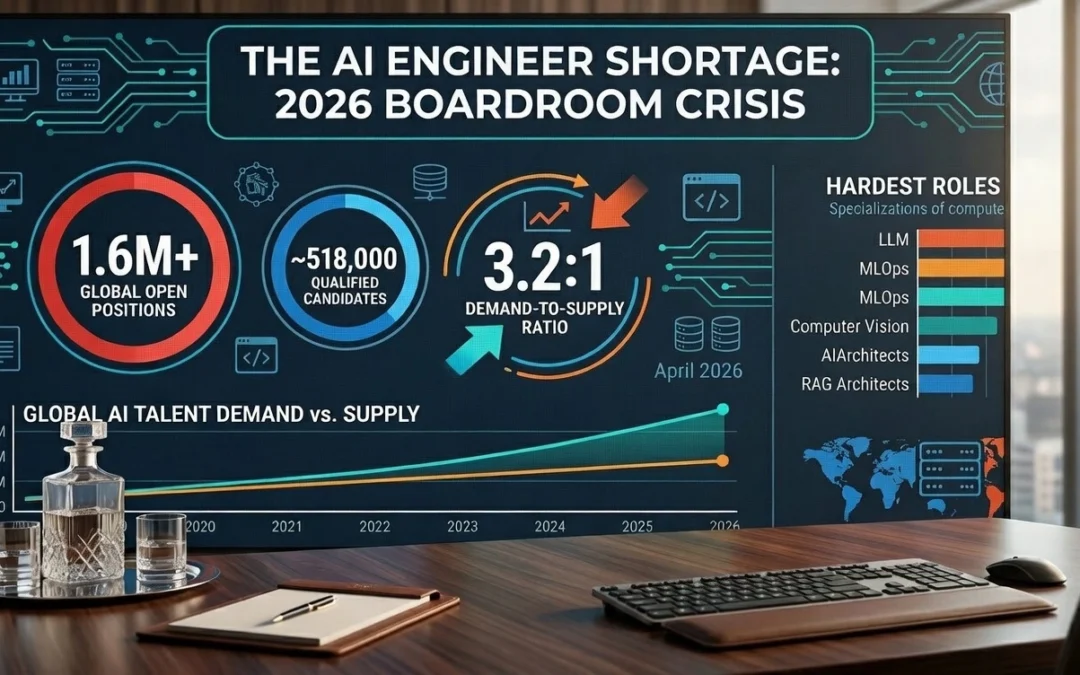
The scale of the AI talent shortage is staggering. According to recent market analysis, global AI talent demand exceeds supply by a ratio of 3.2 to 1, with over 1.6 million open AI positions and only 518,000 qualified candidates available worldwide. That is not a gap — it is a chasm.
| Key Statistic | Figure |
| Global open AI positions | 1.6 million+ |
| Qualified candidates available | ~518,000 |
| Demand-to-supply ratio | 3.2:1 |
| AI job postings growth (2024–2026) | +109% |
| US AI engineer job postings growth (2024–2025) | +143% YoY |
| Business leaders struggling to fill AI roles | 94% |
| Average time to fill a technical AI role | 66 days — 50% longer than non-tech roles |
| Average salary premium for AI engineers vs. traditional software roles | 67% higher |
| WEF projected demand-supply gap by 2027 | 30–40% |
Job postings requiring AI skills grew 73% from 2023 to 2024 and a further 109% from 2024 to 2026 — making it one of the fastest-growing job categories in recorded history. LinkedIn ranked AI engineer as the #1 fastest-growing job title in the United States in 2026. And for the first time, ManpowerGroup’s 2026 Talent Shortage Survey found that AI model development and AI literacy have overtaken traditional engineering and IT as the hardest-to-fill capabilities worldwide.
Why Is the AI Engineer Shortage Getting Worse, Not Better?
The AI talent crisis is not a simple supply-and-demand problem. It is the result of several structural forces colliding at the same time.
1. AI Is Moving from Pilot to Production
From 2023 to 2025, most companies were experimenting with AI. In 2026, the experimentation phase is over. Businesses are now deploying AI into core operations — and that requires a completely different, more advanced skill set. GPU orchestration, model serving at scale, LLM integration, MLOps pipelines, and monitoring for model drift are now engineering problems that require experienced practitioners. The demand is not just additive; it is urgent.
2. Universities Cannot Keep Up
Academic programs have a 3–5 year lag in curriculum. Students graduating today were studying syllabi designed before tools like LangChain, RAG pipelines, and multimodal AI existed at scale. Fewer than half of the 200,000 annual engineering graduates in the US actually enter engineering careers, and of those who do, most lack real production-ready AI experience. Bootcamps and fast-track programs are filling part of this gap, but nowhere near fast enough.
3. The Senior Engineer Gap Is Extreme
There is an important nuance here: the shortage is not universal. Junior AI developers are in relatively better supply. The real crisis is at the senior and specialist level — engineers who can own complex systems in production, make sound architectural decisions, and lead AI initiatives from concept to deployment. This bifurcation means that simply posting a job ad will not solve your problem. You need access to a curated, pre-vetted pipeline of senior AI talent.
4. Hyper-Specialization Is Raising the Bar
Over 75% of AI job listings specifically seek domain experts — generalists need not apply. Roles in LLM fine-tuning, computer vision engineering, RAG architecture, and MLOps are not interchangeable. Each requires deep, focused expertise that takes years to develop. The demand for prompt engineers alone has surged by 135.8% in the past year, yet the qualified candidate pool remains tiny.
5. Immigration Policy Constraints
Tightening H-1B visa policies in the United States have further constrained the domestic pipeline for senior AI talent. Many highly skilled international engineers who would previously have relocated to the US are now choosing to remain in their home markets — or are being hired remotely by forward-thinking companies who have adapted their hiring models.
6. AI Is Automating the Entry-Level Pipeline
Here is the compounding problem most shortage analyses miss: AI coding tools like GitHub Copilot and Claude Code are automating the boilerplate, documentation, and scaffolding tasks that were traditionally the training ground for junior engineers. Entry-level tech hiring has effectively declined as a result — which means fewer junior engineers are developing into the senior specialists organizations will need in three to five years. The talent gap is being fed from the bottom of the pipeline, not just the top.
Which AI Engineering Roles Are Hardest to Fill in 2026?
Not all AI roles are equally difficult to source. Based on current market data, the following specializations are experiencing the most severe shortages:
- Machine Learning Engineers — Among the hardest roles to fill since 2020, with demand growing counter-cyclically even during tech layoffs.
- LLM Fine-Tuning Specialists — The most sought-after specialized skill in enterprise AI right now. Engineers skilled in LoRA, QLoRA, RLHF, and instruction tuning command salaries exceeding $300,000.
- MLOps Engineers — Increasingly the bottleneck that determines whether AI investments deliver production value.
- Computer Vision Engineers — High demand in manufacturing, healthcare, retail, and smart city applications, with a very shallow talent pool.
- RAG (Retrieval-Augmented Generation) Architects — A newer specialty with demand growing rapidly as enterprises build knowledge-grounded AI systems.
- AI Solutions Architects — Needed to translate AI strategy into scalable, enterprise-grade technical implementations.
- Generative AI Engineers — India alone has just one qualified generative AI engineer for every ten open roles; the global picture is similarly stark.
The average time to fill a senior AI engineering role through traditional recruiting channels is four to six months. For specialized roles, it can stretch even longer. Every month of delay translates directly into delayed product launches, lost competitive ground, and missed revenue opportunities.
The Business Cost of the AI Talent Gap
The AI engineer shortage is not just a hiring inconvenience — it is an existential business threat for companies racing to stay competitive.
The IDC projects the IT skills shortage alone will cause $5.5 trillion in global losses by 2026. Korn Ferry estimates $8.5 trillion in unrealized revenue by 2030 if the talent gap is not addressed. Only 16% of executives currently feel confident in their tech talent supply — and 87.5% of tech leaders in a 2026 Lemon.io survey rated hiring skilled AI engineers as “difficult” or worse. Not one rated it “easy.”
There is also a hidden compounding cost: each empty seat on an AI team creates burnout among the engineers absorbing the load, raising turnover risk for the talent you already have. On the upside, BCG research shows companies that successfully close the gap achieve 2.3× faster AI adoption and 67% higher AI ROI than those still struggling with talent gaps.
For fast-moving sectors like healthcare technology, fintech, and enterprise SaaS, a six-month delay in shipping an AI-powered feature can permanently alter your competitive position. While your team searches for talent through traditional channels, competitors are shipping, capturing market share, and locking in customers.
What Are Smart Companies Doing Right Now? 5 Proven Strategies
The organizations successfully navigating the AI engineer shortage are not waiting for the talent market to improve. They are deploying a combination of strategies that reduce time-to-hire, expand the available talent pool, and maximize the output of engineers they already have.
Strategy 1: Partner with a Pre-Vetted AI Talent Platform
Traditional recruiting takes four to six months. Staffing agencies with pre-vetted talent pipelines can deliver qualified candidates within days, not months. Platforms like Divogue maintain a network of 350,000+ pre-screened AI engineers across the globe, enabling companies to hire top talent up to 3x faster than traditional methods — at up to 50% lower cost than equivalent US-based hires.
The key differentiator is the upfront vetting. When talent is pre-screened for technical depth, production experience, and communication skills, you bypass the months-long screening process entirely. You interview candidates who are already qualified, not candidates who might be.
Strategy 2: Expand Your Talent Search Globally
Restricting your AI hiring to a single city, state, or country artificially limits your candidate pool to a fraction of available talent. The best AI engineers in 2026 are distributed across Asia-Pacific, Latin America, Eastern Europe, and beyond. Remote-first hiring models unlock this global talent pool without sacrificing quality — and often deliver significant cost savings.
AI engineer salaries in competitive markets like the US are now regularly exceeding $200,000 in base salary, with total compensation packages at top labs reaching $295,000. By accessing offshore or nearshore talent through a trusted partner, companies can access the same caliber of engineering expertise at 40–60% lower cost.
Strategy 3: Invest in AI Upskilling for Existing Engineers
Engineers who can direct, review, and govern AI output will be worth 2–3x their previous productivity. This is the highest-ROI upskilling investment available in 2026. Identify your strongest existing engineers and invest in accelerated AI training programs, not just for general AI literacy, but for the specific tools and frameworks your business needs.
Strategy 4: Use Flexible Engagement Models
Not every AI initiative requires a full-time hire. For project-based work, proof-of-concept builds, or specialist tasks like model fine-tuning or computer vision integration, contract and fractional AI engineers offer speed and flexibility that permanent hiring cannot match. Companies that maintain a hybrid of full-time core engineers and a flexible roster of vetted contract specialists consistently outpace those that rely on one model alone.
Strategy 5: Start the Hiring Process Before You Need to
The single most common mistake companies make in a talent-scarce market is waiting until a role is urgent to begin recruiting. Given that specialized AI roles take months to fill through traditional channels, pipeline-building must happen continuously — not reactively. The best talent is almost never actively job searching. They are being approached directly by companies with existing relationships in the right talent networks.
In-House Hiring vs. a Pre-Vetted Talent Partner: Side by Side
For companies evaluating how to close their AI engineering gap, the decision often comes down to a direct comparison between building a traditional recruitment pipeline and using a pre-vetted talent partner. Here is how the two approaches stack up across the metrics that matter.
| Metric | Traditional In-House Hiring | Divogue |
| Time to first interview | 2–6 weeks (sourcing, screening) | Within 24–48 hours |
| Time to hire | 66 days average for senior AI roles | 7–14 days |
| Technical vetting | Done by your team (bandwidth cost) | Pre-screened, top 1% verified |
| Salary costs | US market rates + benefits ($180–250K+ total comp) | Up to 50% lower via global talent |
| Talent pool size | Local or national market only | Global pre-vetted network |
| Flexibility | Permanent hires, fixed headcount | Scale up/down per roadmap phase |
| Compliance & payroll | You handle internationally | Managed end-to-end |
| Failed hire risk | High — avg $20K+ per assessment failure | Replacement guarantee included |
| Roles supported | Whatever your recruiter can reach | AI/ML, MLOps, LLM, FDE, Data Eng |
The comparison reflects a simple reality: when the talent pool is structurally undersupplied, the companies that win are the ones that access that pool faster, with less friction, and at a broader geographic scope than their competitors.
How Divogue Solves the AI Engineer Shortage for Fast-Growing Companies
At Divogue, we built our business around exactly this problem. We recognized early that the AI talent gap was not a temporary market fluctuation — it is a structural challenge that requires a fundamentally different approach to engineering recruitment.
Our pre-vetted community of AI engineers spans machine learning, computer vision, generative AI, RAG, MLOps, and full-stack AI development. Every engineer in our network has passed a rigorous multi-stage vetting process covering technical assessment, production experience, and communication capability. When you work with Divogue, you are not reviewing unfiltered applicants — you are choosing from a curated shortlist of proven engineers.
What sets Divogue apart:
- Access to 350,000+ pre-vetted AI engineers across 40+ countries
- Candidates delivered within 24–48 hours of your request
- Up to 3x faster hiring than traditional recruiting channels
- Up to 50% cost savings versus US-based equivalent hires
- 2-week trial period — so you can verify fit before committing
- Flexible models: full-time, contract, fractional, and RPO
- Ongoing support and quality assurance throughout the engagement
Fortune 500 companies and fast-scaling SMEs trust Divogue to build their AI teams because speed and quality are not a trade-off when you have the right talent pipeline. Companies like BGO Software, Riskcast Solutions, and Science4Data have relied on Divogue to deliver AI engineers who feel like an extension of their internal team — not an external vendor.
The AI Engineer Shortage: What to Expect in 2027 and Beyond
The World Economic Forum projects that demand for AI and data roles will exceed supply by 30–40% by 2027 — and that gap is widening. The global AI market is on track to exceed $3 trillion by 2033. AI engineer salaries have already jumped to an average of $206,000 in the US, a $50,000 increase from the previous year. There is no sign of this trend reversing.
What this means practically: the companies that build strong AI engineering pipelines today will have a durable structural advantage over competitors who wait. Access to top AI talent is increasingly a competitive moat — not just a hiring problem.
The window to act is open, but it is narrowing. Early movers are locking in the best engineers through long-term partnerships. The companies that wait for the talent market to normalize are the ones that will be playing catch-up when it matters most.
Conclusion: The AI Engineer Shortage Is a Solvable Problem — If You Act Now
The 2026 AI engineer shortage is real, severe, and not going away on its own. With a 3.2:1 demand-to-supply ratio, 1.6 million open positions globally, and salaries rising 15–20% annually, traditional hiring approaches are simply not built for this environment.
But the companies that adapt — by partnering with pre-vetted talent platforms, expanding their geographic hiring reach, and investing in flexible engagement models — are finding and retaining world-class AI engineers faster than their competitors even begin their search.
If you are ready to close your AI talent gap, Divogue is ready to help. Our network of 350,000+ pre-vetted AI engineers is available now — and our clients typically meet matched candidates within 24 hours of reaching out.
Start your 2-week trial today at divogue.net
Frequently Asked Questions (FAQ)
What is causing the AI engineer shortage in 2026?
The shortage is driven by multiple converging factors: AI moving from pilot to production across every major industry, universities struggling to produce job-ready graduates fast enough, hyper-specialization raising the skill bar, AI tools automating the entry-level roles that traditionally built senior talent, and immigration policy constraints limiting the US domestic talent pipeline. Demand for AI roles is growing at over 100% per year while the qualified talent pool grows at a fraction of that rate.
How long does it take to hire an AI engineer in 2026?
Through traditional recruiting channels, filling a senior AI engineer role takes four to six months on average. Specialized roles in LLM fine-tuning, computer vision, or MLOps can take even longer. Pre-vetted talent platforms like Divogue reduce this to 24–48 hours for initial candidate delivery.
What AI engineering roles are hardest to hire for?
The hardest roles to fill are LLM fine-tuning specialists, MLOps engineers, computer vision engineers, RAG architects, and senior machine learning engineers with production deployment experience. These roles combine deep technical expertise with practical engineering judgment that takes years to develop.
How can companies hire AI engineers faster in 2026?
The most effective strategies are: partnering with a pre-vetted AI talent platform, expanding your search to global remote talent pools, using flexible contract or fractional engagement models for specialist needs, and building a continuous talent pipeline rather than reacting to urgent vacancies.
How much does an AI engineer cost in 2026?
US-based AI engineers now earn an average of $206,000 in base salary, with total compensation packages at leading AI labs reaching $277,000–$295,000. Offshore AI engineers through a trusted staffing partner like Divogue typically cost 40–60% less than equivalent US-based hires, with no compromise on technical quality.