By Divogue Editorial Team · April 2026 · 12 min read · AI Hiring & Talent Strategy
Everyone says they need an “AI engineer.” But in 2026, that title covers at least four completely different jobs — and hiring the wrong subtype is one of the most expensive mistakes a tech team can make.
Most hiring managers conflate Generative AI engineers with traditional machine learning engineers. They share some vocabulary, and sometimes some tools, but they are not the same role. ML engineers build and train predictive models. Generative AI engineers build systems powered by large language models (LLMs), multimodal architectures, and agentic pipelines that create, reason, and automate at a scale that classical ML never could.
If your company is building a customer-facing chatbot, an internal knowledge assistant, an AI content pipeline, or an autonomous workflow agent — you need a Generative AI engineer, not an ML generalist.
This guide tells you exactly what to look for, how to assess them, where to find them, and what it will cost in 2026.
What Is a Generative AI Engineer, Really?
A Generative AI engineer (also commonly called an LLM engineer or GenAI developer) builds production-grade AI systems powered by large language models and generative architectures. Their work sits at the intersection of software engineering, machine learning, and product thinking.
They are not:
- A data scientist who builds predictive models and dashboards
- A traditional ML engineer focused on classical training pipelines and feature engineering
- A prompt engineer who writes prompts without understanding the engineering layer beneath them
A true GenAI engineer does the work that happens after the demo: grounding AI outputs in real business data, preventing hallucinations at scale, connecting LLMs to enterprise systems, and keeping models stable in production as usage grows.
Their core responsibilities include:
- Integrating foundation models (GPT-4o, Claude, Gemini, Llama, Mistral) into live applications
- Building Retrieval-Augmented Generation (RAG) pipelines that connect LLMs to proprietary data
- Fine-tuning and customizing models using techniques like LoRA and QLoRA for domain-specific tasks
- Designing and deploying AI agents — systems that reason, plan, and take multi-step actions
- Building multimodal AI systems that process both text and images (or audio, video)
- Setting up inference infrastructure: latency management, GPU optimization, and cost controls
- Implementing evaluation frameworks to measure output quality, accuracy, and safety
The 4 GenAI Engineer Subtypes — And Why They Matter
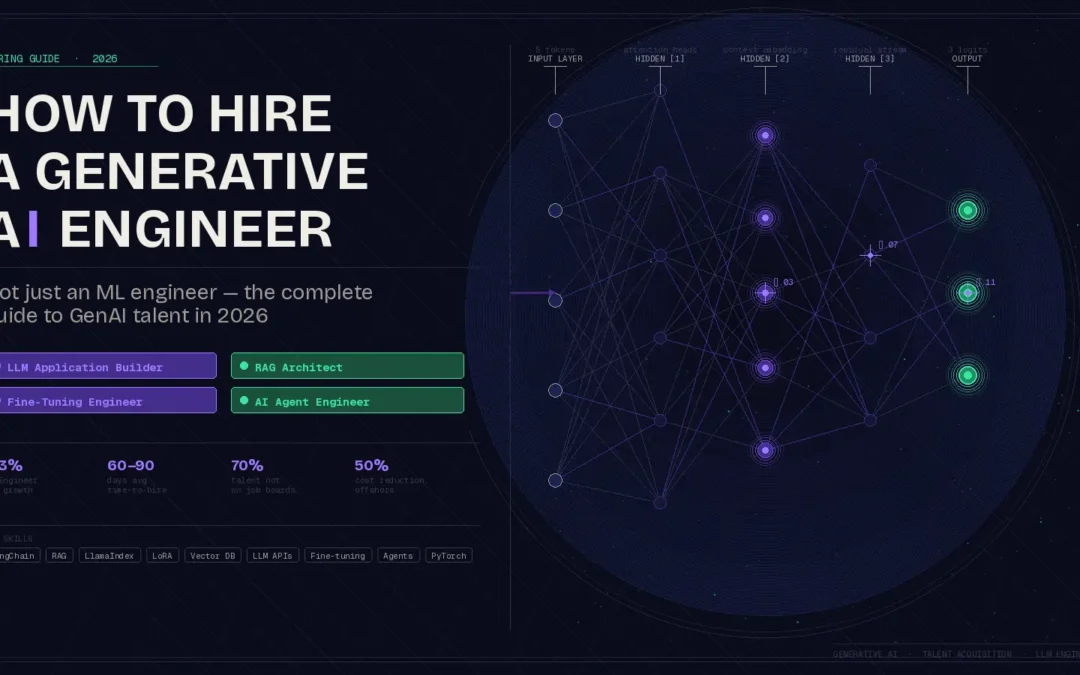
One of the most common hiring mistakes is treating “Generative AI engineer” as a single role. In practice, there are four distinct subtypes, each requiring a different skill profile. Hiring the wrong one for your specific use case sets projects back by months.
1. LLM Application Builder
Builds user-facing products powered by language models — chatbots, writing assistants, summarization tools, classification pipelines, and conversational AI interfaces. Uses frameworks like LangChain or LlamaIndex and strong software engineering fundamentals.
Hire this person when: You’re building a customer-facing AI product or internal productivity tool.
2. RAG Architect
Specializes in Retrieval-Augmented Generation pipelines — the systems that connect LLMs to your company’s proprietary knowledge base so the model answers from facts, not hallucinations. Deep knowledge of vector databases (Pinecone, FAISS, Weaviate, Qdrant), embedding models, semantic search, and information retrieval architecture.
Hire this person when: Your AI needs to answer questions from your internal documents, databases, or domain-specific knowledge.
3. Fine-Tuning & Model Customization Engineer
Adapts foundation models to your domain, tone, and business logic. Requires deep ML theory, training infrastructure experience, and hands-on knowledge of LoRA, QLoRA, RLHF, and model evaluation. Also needs GPU budget fluency and familiarity with platforms like Hugging Face and Weights & Biases.
Hire this person when: Off-the-shelf model behavior doesn’t meet your accuracy, tone, or compliance requirements.
4. AI Agent & Autonomous Systems Engineer
Designs and builds agentic AI systems — multi-step reasoning pipelines where AI takes actions, uses tools, calls APIs, and makes decisions with minimal human intervention. Works with frameworks like AutoGen, CrewAI, LangGraph, and multi-agent orchestration systems.
Hire this person when: You’re automating complex workflows, building AI copilots, or want AI to take actions rather than just answer questions.
The Core Skills to Evaluate When You Hire a Generative AI Engineer
When assessing candidates for any GenAI role, these are the non-negotiable technical competencies to screen for in 2026:
Foundation Model Fluency
The candidate should have hands-on experience working with multiple LLM providers — not just one. Familiarity with GPT-4o, Claude 3.5, Gemini 1.5 Pro, Llama 3, and Mistral models is a strong signal. They should understand the tradeoffs between models: context window size, cost per token, latency, multimodal capabilities, and fine-tuning availability.
RAG Pipeline Development
RAG is now a core competency for virtually every GenAI role. Look for candidates who can architect end-to-end pipelines: document ingestion, chunking strategies, embedding selection, vector store management, query optimization, and output evaluation. Ask them to walk through a RAG system they’ve built and explain every design decision.
Python and LLM Frameworks
Strong Python is table stakes. Beyond that, look for experience with LangChain, LlamaIndex, Haystack, or similar orchestration frameworks. They should understand when to use a framework and when to build custom.
Prompt Engineering (as a System Design Skill)
Important clarification for 2026: prompt engineering as a standalone career is largely obsolete. Current foundation models interpret user intent well enough that dedicated “prompt engineers” are rarely justified. What matters is whether a GenAI engineer understands prompt design as part of system design — chain-of-thought prompting, few-shot examples, structured output formatting, and prompt injection defense.
Production Deployment Experience
This is the hardest skill to fake. Look for candidates who have shipped AI systems to real users, not just built demos. They should be comfortable with inference optimization, latency benchmarking, model monitoring, cost tracking, and handling model failures gracefully in production.
Multimodal Experience (Increasingly Required)
In 2026, most enterprise AI products are moving toward multimodal capabilities — systems that process both text and images, or text and audio. Candidates with hands-on experience building multimodal LLM applications are significantly more valuable and harder to find.
Red Flags to Watch For
Generative AI hiring is uniquely prone to inflated credentials because the field moves fast and verification is hard. These are the warning signs to watch for:
“I’ve used ChatGPT extensively.” Using a consumer product is not the same as engineering with the underlying API. Probe for system-level thinking, not chat-level familiarity.
Impressive demos, no production history. Many candidates can build a compelling 10-minute demo with a notebook and an API key. Ask specifically: “Tell me about a GenAI system you built that served real users. What broke, and how did you fix it?”
Can’t explain hallucination mitigation strategies. Any legitimate GenAI engineer should be able to describe at least three concrete approaches to reducing hallucinations in deployed LLMs — RAG grounding, confidence scoring, output validation layers, etc.
No cost awareness. Production GenAI systems can run expensive cloud bills fast. Strong candidates think about tokens per query, caching strategies, model selection for cost vs. accuracy tradeoffs, and inference optimization.
Relies on one framework or one model provider. The LLM landscape changes every quarter. Engineers overly attached to a single tool or model tend to build brittle systems.
How to Structure the Technical Interview
Standard algorithm-heavy coding tests are the wrong filter for GenAI engineering roles. They test for the wrong things. Here’s a more effective assessment structure:
Round 1: System Design
Ask the candidate to design a RAG-based knowledge assistant for a company with 50,000 internal documents. Evaluate their reasoning on chunking strategy, embedding model selection, vector database choice, query routing, and latency management. You’re not looking for one right answer — you’re looking for structured tradeoffs and production thinking.
Round 2: Take-Home Technical Task (2–4 hours)
A realistic take-home challenge: Build a small question-answering system using the provided set of documents. Include your choice of embedding model, vector store, and LLM. Add an evaluation metric and a rough cost estimate for 10,000 queries per day.
This reveals real problem-solving ability, code quality, and whether they think about production constraints — not just whether they can make something work.
Round 3: Past Project Breakdown
Ask them to walk through the most complex GenAI system they’ve built. Probe for specifics: What vector database did you use and why? How did you handle context window limitations? What was your evaluation strategy? What would you do differently now? Vague answers are a red flag; precise architectural reasoning is a green flag.
Round 4: Hallucination & Failure Mode Discussion
Ask: “You’ve deployed an LLM-powered assistant that begins giving confidently wrong answers at scale. Walk me through your debugging and mitigation process.” The best candidates have a structured answer from experience, not theory.
Where to Find Generative AI Engineers in 2026
The supply-demand gap for qualified GenAI talent is real and widening. Roughly 70% of senior generative AI engineers are not actively looking for jobs — they’re employed, well-compensated, and not on job boards. A job posting alone will not reach the best candidates.
GitHub and Hugging Face — Search contributors to popular LLM projects, RAG libraries, and vector database integrations. Active open-source contribution is one of the strongest signals of genuine GenAI depth.
AI-focused staffing partners — Working with a vetted AI talent platform like Divogue gives you access to pre-screened engineers who have been tested on real-world GenAI tasks, not just resume-filtered. This dramatically reduces time-to-hire and the risk of a mis-hire.
LinkedIn with specific skill filters — Filter by LangChain, RAG, LlamaIndex, fine-tuning, or specific model platforms rather than the generic “AI engineer” title. Keyword precision matters.
AI conferences and community spaces — NeurIPS, MLOps World, AI Engineer Summit, and Discord communities around LangChain or Hugging Face are where working GenAI engineers spend their time.
What Does It Cost to Hire a Generative AI Engineer in 2026?
Compensation varies significantly by subtype, seniority, and geography. These figures reflect market ranges as of early 2026:
| Role | US Base Salary | Offshore (South/Southeast Asia) |
|---|---|---|
| LLM Application Builder (mid) | $130,000 – $160,000 | $40,000 – $70,000 |
| RAG Architect (senior) | $160,000 – $200,000 | $55,000 – $90,000 |
| Fine-Tuning Engineer (senior) | $170,000 – $220,000 | $60,000 – $95,000 |
| AI Agent Engineer (senior) | $165,000 – $210,000 | $55,000 – $90,000 |
Important: Base salary is not the full cost. Factor in 20–30% overhead for benefits, payroll taxes, and recruiting fees if hiring full-time in the US. Offshore and staff augmentation models through vetted platforms like Divogue reduce total cost by 40–60% while maintaining senior-level quality, and typically place candidates 3x faster than traditional recruiting.
The Hiring Timeline Reality
Current average time-to-hire for tech roles broadly is around 44 days. For senior GenAI roles — particularly RAG architects and fine-tuning engineers — expect 60 to 90 days on a well-resourced, fast-moving search. If you have a hard project deadline, start your search significantly earlier than feels necessary.
If speed is critical, pre-vetted talent platforms and AI staffing agencies that specialize in GenAI roles offer the fastest path to qualified candidates — often placing engineers in 1–2 weeks compared to 2–3 months through traditional hiring.
Quick Checklist: Before You Post the Job Description
Before sourcing candidates, answer these three questions clearly:
- What specific AI system are you building? A customer-facing chatbot, an internal RAG assistant, an autonomous workflow agent, and a multimodal product all require different engineers.
- Do you need production experience or prototype experience? Junior GenAI engineers can ship demos fast. Senior engineers can ship systems that stay stable for two years.
- What’s your infrastructure preference? Cloud-native (AWS Bedrock, Azure OpenAI, GCP Vertex), self-hosted open-source models, or hybrid? This shapes which engineers to prioritize.
Final Thoughts
Generative AI engineering in 2026 is not a single job. It’s a cluster of distinct, highly specialized roles that require different skills, different assessment strategies, and different expectations.
The companies that are winning the GenAI race are not necessarily the ones who posted the job first — they’re the ones who defined the right role, vetted for production experience over demo capability, and partnered with talent networks that already had the engineers they needed.
If you’re ready to find a vetted Generative AI engineer who can ship real systems — not just a compelling proof-of-concept — Divogue connects you with pre-screened GenAI talent in days, not months.
Published by Divogue · Updated April 2026 · Categories: AI Hiring, Generative AI, LLM Engineering, Tech Talent
Tags: hire generative AI engineer, generative AI developer, LLM engineer, how to hire GenAI engineer, RAG engineer, AI talent 2026, generative AI skills, LLM application development, AI staffing, hire AI developers, GenAI hiring guide, multimodal AI engineer