Imagine you never open a browser again. You describe what you want, and an AI agent books the flight, compares the hotels, fills the form, and sends you the confirmation — while you do something else entirely.
AI agents aren’t a feature inside the internet — they’re replacing how people interact with it. The biggest shift since the smartphone.
The AI agents market hit $10.9 billion in 2026 and is forecast to reach $182.97 billion by 2033 — a 49.6% compound annual growth rate. That’s not a trend. That’s a structural replacement.
Divogue Insight: At Divogue, our AI engineers have been building autonomous agent systems for companies across healthcare, finance, and e-commerce — long before “AI agents” became a boardroom buzzword. Here’s everything you need to know about what’s coming.
1. What are AI Agents? Agentic AI Explained
An AI agent is software that can set its own sub-goals, use tools, and take sequences of actions to complete a task — without a human directing every step.
The Agentic Shift
-
Contrast with Chatbots: A chatbot answers questions; an agent gets things done. A chatbot tells you the weather; an agent reschedules your outdoor meeting and notifies the attendees.
-
4 Core Capabilities: Memory, planning, tool use (APIs, browsers, calendars, databases), and autonomy.
-
The Key Distinction: Traditional AI responds to prompts. Agentic AI takes initiative, adapts when things change, and works toward goals across your entire organization.
The Divogue Difference: Building a reliable AI agent requires more than prompting a language model — it demands expertise in LLMs, RAG pipelines, AWS infrastructure, and systems design. Divogue engineers like Muhammad Jamshaid and Maria Alvi specialize in exactly this stack: AI/ML, RAG, LLMs, and AWS — the full combination required to deploy agents that actually work in production.
2. The Numbers: AI Agent Adoption Statistics 2026
The explosion in enterprise adoption signals that this has crossed from “interesting experiment” into core infrastructure.
-
79% of organizations have adopted AI agents to some extent in 2026.
-
Gartner: 40% of enterprise apps will include task-specific AI agents by end of 2026, up from under 5% in 2024.
-
Velocity: Tasks AI agents complete autonomously at 50% success rate have been doubling every 7 months.
-
Investment: 92% of companies plan to increase AI budgets in the next 3 years.
There is a massive maturity gap: only 6% of organizations are true AI high performers. Wide adoption + thin expertise = enormous opportunity for those who move with the right engineers now.
Strategic Talent: The gap between companies using AI and companies transforming with AI comes down to one thing: engineering talent. Divogue’s pre-vetted AI engineers — with an average of 6–7 years of hands-on AI/ML experience — are the bridge across that gap. Clients like Riskcast Solutions, BGO Software, and Science4Data are already on the right side of that divide.
3. Real Examples: AI Automation ROI
Concrete examples are the credibility engine of this shift.
-
Manufacturing: AI agents simulate factory operations in digital twins — delivering 20% throughput increases and 15% capex reductions.
-
Healthcare: AI clinical assistants reduced documentation time by 42%, saving nurses 66 minutes per day with 80% adoption.
-
Customer Service: Fully autonomous agents handling refunds, escalations, and omnichannel support — saving teams 40+ hours per month.
-
Sales Pipelines: Multi-agent systems delivering 2–3x pipeline velocity improvements with automated lead gen, outreach, and qualification.
Built by Divogue: These aren’t future projections — they’re the types of systems Divogue engineers are being hired to build right now. From multi-agent pipelines using Python and RAG to computer vision models for operational automation, Divogue’s talent network covers every layer of the agent stack. Talk to a Divogue AI specialist →
4. Industries at the Forefront
-
Telecom: 48% adoption rate — highest of any sector.
-
Retail/CPG: 47% adoption in inventory, personalization, and customer support agents.
-
Healthcare: AI applications could generate $150B in annual savings. Agents handling monitoring, diagnostics, and clinical notes.
-
Finance/Ops: Automated forecasting agents accelerating financial close by 30–50%.
-
Software Engineering: Agents writing, reviewing, and deploying code — already a top-3 global use case.
Domain Expertise: Divogue provides pre-vetted AI engineers with domain experience across these exact industries — from Flutter developers building patient-facing healthcare apps to AI/ML engineers deploying recommendation engines for retail clients. Whether you need one specialist or a full team, Divogue assembles the right talent up to 3× faster than traditional recruiting.
5. Architecture: The Agentic Web Rewrite
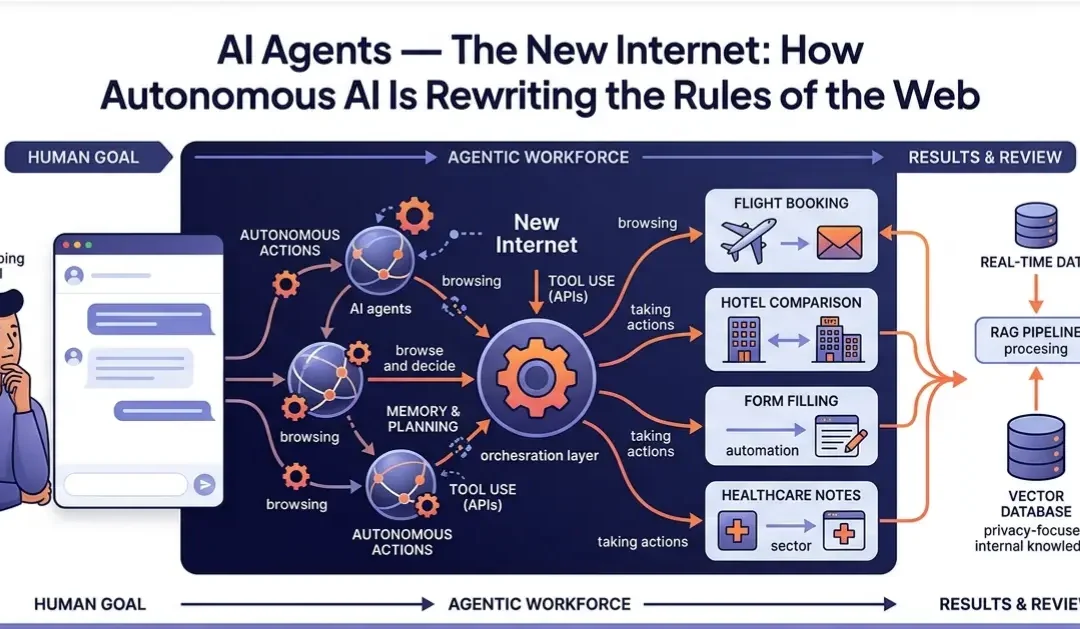
The web is shifting from “Human browses web → finds info → acts” to “Human states goal → agent browses, decides, acts → human reviews.”
The Orchestration Layer
We are seeing the rise of “Kubernetes for agents.” Just as containers needed orchestration to scale, agents need coordination layers to operate safely at enterprise scale. By 2028, 33% of enterprise software applications will have built-in agentic capabilities.
The Technical Stack: The technical stack for a production-ready AI agent is non-trivial: it requires LLM integration, RAG pipelines for memory, AWS infrastructure for scalability, and Neo4j or similar graph databases for knowledge retrieval. These are exactly the technologies Divogue’s engineers are certified and experienced in — not as generalists, but as specialists.
6. The Dark Side: Risks and Governance
Over 40% of AI agent projects fail in 2026. Trust is built through honesty about these hurdles:
-
Governance Gap: 42% of companies feel highly prepared strategically; only 30% feel prepared on risk and governance.
-
Agent Sprawl: Uncoordinated deployment creates security and compliance risks.
-
Adoption Friction: Only 13% of non-technical workers are highly enthusiastic about AI.
-
Hallucination at Scale: An agent that makes a wrong decision doesn’t just give a bad answer — it takes a bad action.
Risk Mitigation: This is exactly why choosing the right AI engineers matters more than choosing the right AI tools. Divogue’s consultancy process includes discovery workshops and digital transformation planning — ensuring agent deployments are built with governance, security, and performance standards from day one, not retrofitted after something breaks.
7. Action Plan: Implementing Agentic AI
-
Audit your workflows for agent-readiness. Map repeatable processes with clear inputs/outputs.
-
Make your systems agent-readable. Ensure clean APIs and structured data.
-
Start with one governed pilot. Pick one use case and tie it to measurable KPIs.
-
Hire the right engineering talent. Agent development requires a specific combination of skills generalists lack.
Only 23% of companies use agentic AI moderately today. Within two years, Deloitte expects 74%. The window to build a head start is measured in months, not years.
Take the First Step: Not sure where to start? Divogue offers a free consultation to help you map your first AI agent use case — and match you with pre-vetted engineers who have built exactly what you’re trying to build. Start your free consultation → Or try Divogue’s risk-free 2-week trial before committing to a full engagement.
8. The Future: 2028 and Beyond
By 2028, 15% of routine workplace decisions will be made autonomously. Cognitive AI tools will handle 20% of interactions at digital storefronts, shifting away from human-navigated interfaces entirely.
The first internet gave everyone a webpage. The second gave everyone social media. The third gave everyone an AI assistant. The internet gives everyone a workforce.
Partner for the Future: The companies building that workforce today are partnering with engineering teams who understand this technology at a deep level — not just the tools, but the architecture, the tradeoffs, and the failure modes. That’s what Divogue’s talent network was built for.
Closing: Built for This World or the Last One?
The internet didn’t ask permission to replace encyclopedias. AI agents aren’t asking permission to replace browsing. The only question is whether your business is being built for this world — or the last one.
The difference between the 6% of high performers and everyone else is engineering depth and execution speed.
If you’re serious about building AI agents that actually work in production — not demos, not prototypes, but systems your business runs on — Divogue is where you start.
-
✅ 350,000+ pre-vetted AI engineers in our network
-
✅ Teams assembled up to 3× faster than traditional hiring
-
✅ Up to 50% cost reduction vs in-house recruitment
-
✅ Risk-free 2-week trial on every engagement