Published by Divogue | Updated April 2026 | 10 min read
The demand for AI engineers has never been higher. According to LinkedIn’s 2026 Emerging Jobs Report, AI Engineer is the #1 fastest-growing job title in the United States, with job postings rising 143% year over year. Yet for most hiring managers, evaluating these candidates is the hardest part of the process.
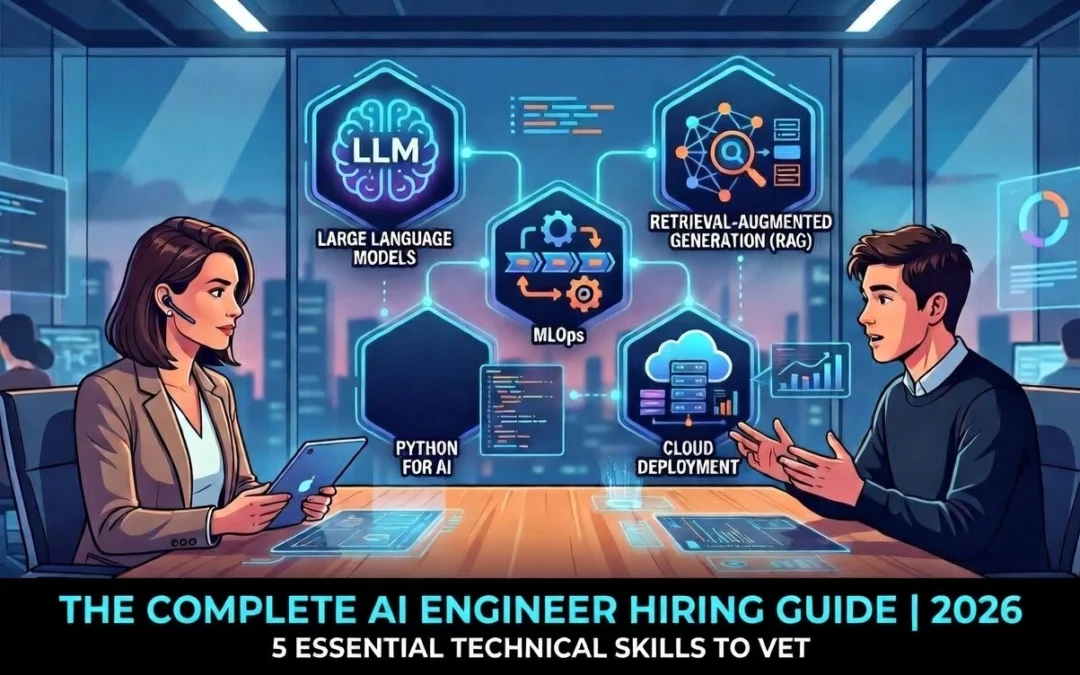
Unlike traditional software engineers, AI engineers operate across a unique and rapidly evolving technical stack: large language models (LLMs), retrieval-augmented generation (RAG), machine learning operations (MLOps), Python-based AI frameworks, and cloud infrastructure for model deployment. Screening for all of these requires a structured, deliberate approach.
This guide gives you the complete technical interview framework for hiring AI engineers in 2026 — with actionable interview questions, skill benchmarks by seniority, and red flags to watch for at every stage.
| Who is this guide for?
CTOs, Engineering Managers, and Talent Leaders hiring AI engineers, ML engineers, or LLM developers for their teams. Whether you’re building an in-house AI team or vetting offshore AI talent, this playbook applies. |
Why Hiring AI Engineers Is Different From Traditional Tech Hiring
Most technical hiring frameworks were designed for software engineers: data structures, algorithms, system design. But AI engineers live in a different world. Their work involves probabilistic systems, model evaluation, data pipelines, and real-time inference — none of which are well-tested by a LeetCode whiteboard round.
Here is what sets AI engineering interviews apart:
- The stack changes fast. Skills that were niche in 2023 (RAG, vector databases, LLM fine-tuning) are now baseline requirements in 2026.
- Theoretical ML knowledge does not equal production readiness. Many candidates can explain transformers but have never deployed a model at scale.
- Domain context matters. An AI engineer building healthcare diagnostics needs different skills than one building a retail recommendation engine.
- Evaluation is qualitative and quantitative. You need to test both code quality and judgment — how a candidate thinks through trade-offs matters as much as syntax.
1. Large Language Models (LLMs): The Foundation of Modern AI Engineering
Understanding large language models is now table stakes for any AI engineer. But surface-level familiarity with GPT-4 or Claude is not enough. Hiring managers need to test whether candidates can work with LLMs at an engineering level — fine-tuning, prompt engineering, evaluation, and inference optimization.
Core LLM Skills to Evaluate
- Transformer architecture fundamentals (attention mechanisms, tokenization, context windows)
- Prompt engineering and prompt chaining for production use cases
- LLM fine-tuning using PEFT, LoRA, or full parameter fine-tuning
- Model evaluation using benchmarks such as MMLU, HumanEval, and custom task-specific evals
- LLM API integration (OpenAI API, Anthropic API, Hugging Face Inference API)
- Handling hallucinations, bias, and output reliability in production systems
LLM Interview Questions (By Seniority)
Mid-Level (2–4 years):
- Explain the difference between zero-shot, few-shot, and chain-of-thought prompting. When would you use each?
- You’re using an LLM that keeps hallucinating facts. What strategies do you use to reduce this in a production system?
- Walk me through how you would fine-tune an open-source LLM like Mistral or LLaMA 3 for a specific business task.
Senior-Level (5+ years):
- How would you design an LLM evaluation pipeline for a customer support automation system? What metrics would you track?
- Describe a time you optimized LLM inference latency in a production system. What trade-offs did you make?
- How do you approach model selection when choosing between a large proprietary model versus a smaller fine-tuned open-source model?
| Red Flag to Watch For
Candidates who can only discuss publicly available LLM demos but have never integrated an LLM into a production codebase. Look for GitHub projects, deployed apps, or portfolio evidence of real LLM engineering work. |
2. Retrieval-Augmented Generation (RAG): The Most In-Demand AI Architecture of 2026
RAG has become one of the most important architectural patterns in enterprise AI. By grounding LLM outputs in real-time, domain-specific data retrieved from vector databases or document stores, RAG systems dramatically improve accuracy and reduce hallucinations. Nearly every enterprise AI product in 2026 uses some form of RAG.
Core RAG Skills to Evaluate
- Vector database design and operation (Pinecone, Weaviate, Qdrant, pgvector)
- Embedding models and semantic search implementation (OpenAI embeddings, Sentence Transformers, Cohere)
- Chunking strategies for document ingestion and retrieval accuracy
- RAG pipeline orchestration using LangChain, LlamaIndex, or custom implementations
- Hybrid search combining dense retrieval with keyword-based BM25 search
- RAG evaluation frameworks: RAGAS, TruLens, or custom ground-truth benchmarks
RAG Interview Questions (By Seniority)
Mid-Level:
- Walk me through how you would build a RAG pipeline to answer questions from a 500-page internal policy document.
- What chunking strategy would you use for a legal document corpus, and why?
- How do you evaluate whether your RAG system is actually retrieving the right context?
Senior-Level:
- How would you design a multi-tenant RAG system where each client has isolated, private knowledge bases?
- Describe an architecture where you combined RAG with tool-calling agents. What were the key design decisions?
- Your RAG system retrieves correctly 80% of the time, but the LLM still generates wrong answers. How do you debug this?
| Pro Tip for Hiring Managers
Ask candidates to whiteboard a RAG pipeline end-to-end: document ingestion → chunking → embedding → vector storage → retrieval → prompt construction → LLM → response. Strong candidates will identify where failure points occur and how to instrument each stage. |
3. MLOps: Separating Prototype Builders From Production Engineers
MLOps — the intersection of machine learning and DevOps — is where most AI projects fail. A candidate can build an impressive model locally, but if they cannot deploy it reliably, monitor it in production, and maintain it over time, your AI initiative will stall. MLOps skills directly predict whether an AI engineer can deliver business value.
Core MLOps Skills to Evaluate
- Model training pipeline automation (Kubeflow, MLflow, Metaflow, Vertex AI Pipelines)
- Experiment tracking and reproducibility (MLflow Tracking, Weights & Biases, Neptune.ai)
- Model versioning, artifact management, and model registry workflows
- CI/CD for machine learning: automated testing, model validation gates, deployment pipelines
- Model monitoring: data drift detection, concept drift, prediction quality degradation
- Feature stores and data pipeline engineering (Feast, Tecton, dbt)
- Container orchestration for AI workloads: Docker, Kubernetes, Helm charts
MLOps Interview Questions (By Seniority)
Mid-Level:
- How would you set up experiment tracking for a team of five ML engineers working on the same model?
- Walk me through how you would detect and respond to model drift in a production recommendation system.
- What does a healthy CI/CD pipeline look like for an ML project? What tests would you include?
Senior-Level:
- You have a model that performs well in testing but degrades in production after 30 days. Design a full monitoring and retraining system.
- How would you build an MLOps platform from scratch for a 50-person ML team? What tools would you choose and why?
- Describe how you have managed model governance and compliance requirements in a regulated industry such as finance or healthcare.
| Red Flag to Watch For
Candidates who have only worked in Jupyter notebooks and have never productionized a model. Ask specifically: ‘What is the last model you deployed to production, and how did you serve it?’ Vague answers are a warning sign. |
4. Python for AI Engineering: Beyond Basic Scripting
Python remains the dominant language for AI engineering. But the Python skills required for production AI work go far beyond writing scripts in a notebook. You need engineers who can build clean, performant, testable, and maintainable AI systems in Python at scale.
Core Python AI Skills to Evaluate
- Deep proficiency with key AI/ML libraries: PyTorch, TensorFlow, Hugging Face Transformers, scikit-learn
- Asynchronous Python for high-throughput LLM API calls (asyncio, aiohttp)
- Python packaging, dependency management, and virtual environment best practices
- Writing testable ML code: unit tests, integration tests, pytest fixtures for ML pipelines
- Performance optimization: vectorization with NumPy, profiling, memory management
- API development for AI services: FastAPI, Flask for serving ML models
- Data processing at scale: Pandas, Polars, Dask, Apache Spark with PySpark
Python Interview Questions (By Seniority)
Mid-Level:
- Write a Python function that calls an LLM API for 1,000 documents concurrently with rate limiting and retry logic.
- How would you profile a slow Python data pipeline and optimize it? Walk me through your approach.
- Explain the difference between Python generators and lists. When is using a generator important in an AI pipeline?
Senior-Level:
- Design a production-grade Python service that serves an LLM endpoint at 99.9% uptime. What does the architecture look like?
- How do you manage Python dependency conflicts in a team where different ML projects use different library versions?
- You need to process 10 billion rows for model training. Walk me through your Python-based data engineering approach.
5. Cloud Deployment for AI: Infrastructure That Scales
AI systems live in the cloud. From GPU-accelerated model training on AWS SageMaker to real-time inference on Google Cloud Vertex AI to containerized model serving on Azure Kubernetes Service, cloud deployment is now a core competency for AI engineers. Strong candidates understand infrastructure-as-code, cost optimization for GPU compute, and scalable serving architectures.
Core Cloud AI Deployment Skills to Evaluate
- Model serving architectures: real-time inference endpoints vs. batch inference vs. streaming inference
- GPU instance selection and cost optimization on AWS (EC2 P-series), GCP (A100 TPUs), and Azure (NVv4 series)
- Containerization for ML: Docker image optimization for large model weights, multi-stage builds
- Kubernetes for AI workloads: GPU node pools, resource limits, horizontal pod autoscaling for inference
- Managed AI platforms: AWS SageMaker, Google Vertex AI, Azure Machine Learning
- Infrastructure-as-code for ML: Terraform, Pulumi, CloudFormation for reproducible AI infrastructure
- Edge deployment: ONNX model export, TensorRT optimization, deployment to IoT and embedded devices
Cloud Deployment Interview Questions (By Seniority)
Mid-Level:
- Walk me through how you would deploy a fine-tuned LLaMA model to AWS to serve 100 concurrent users.
- How would you estimate and optimize the cloud cost of serving a large language model at scale?
- You need to deploy the same AI model to AWS, GCP, and Azure. How do you abstract the infrastructure to avoid vendor lock-in?
Senior-Level:
- Design a multi-region, highly available AI inference platform that handles 10,000 requests per second with under 200ms latency.
- How would you implement a blue-green deployment strategy for an AI model where degraded performance is unacceptable?
- Describe how you would architect cloud security for an AI system handling regulated healthcare data (HIPAA compliance).
| Red Flag to Watch For
Candidates who have only run cloud tutorials but have never managed production cloud costs for AI workloads. Ask for specific monthly spend figures they have managed or optimized. Real production engineers always remember their cloud bills. |
AI Engineer Skills Matrix: Quick Reference by Seniority Level
Use this table to calibrate your expectations when evaluating AI engineer candidates at different experience levels:
| Skill Area | What to Test | Seniority Level |
|---|---|---|
| LLM Integration | API usage, prompt engineering, output parsing | Mid-Level (2–4 yrs) |
| LLM Fine-Tuning | LoRA, PEFT, RLHF, evaluation pipelines | Senior (5+ yrs) |
| RAG Pipeline | Chunking, embeddings, vector DB, retrieval eval | Mid-Level (2–4 yrs) |
| Advanced RAG | Hybrid search, agentic RAG, multi-tenant architecture | Senior (5+ yrs) |
| MLOps Basics | MLflow, model registry, experiment tracking | Mid-Level (2–4 yrs) |
| MLOps Platform | Full CI/CD for ML, drift monitoring, feature stores | Senior (5+ yrs) |
| Python AI Dev | PyTorch, Transformers, async, FastAPI | Mid-Level (2–4 yrs) |
| Python at Scale | Distributed processing, PySpark, performance optimization | Senior (5+ yrs) |
| Cloud Deployment | Containerization, managed AI platforms, cost awareness | Mid-Level (2–4 yrs) |
| Cloud Architecture | Multi-region, HA inference, IaC, security compliance | Senior (5+ yrs) |
Skip the Screening Burden — Hire Pre-Vetted AI Engineers Through Divogue
Building and running a rigorous AI engineer screening process in-house takes weeks of engineering leadership time. Most hiring teams do not have the depth to evaluate all five skill areas — LLMs, RAG, MLOps, Python, and cloud deployment — simultaneously.
Divogue solves this. We source, technically screen, and pre-vet AI engineers across all of these competencies so your team only interviews candidates who have already passed a rigorous multi-stage technical evaluation.
- Pre-vetted across LLM, RAG, MLOps, Python, and cloud deployment skills
- Hire in as little as 24–48 hours — 3x faster than traditional recruiting
- Up to 50% cost reduction vs. local hiring with no compromise on quality
- Ongoing quality assurance throughout the engagement
- Global talent network: North America, Europe, Latin America, Asia-Pacific
| Ready to Hire a Top AI Engineer?
Visit www.divogue.net to post your role and get matched with pre-vetted AI engineering talent within 24 hours. Our team handles the technical screening — you focus on the final fit interview. |
Frequently Asked Questions
What is the difference between an AI engineer and a machine learning engineer?
An AI engineer typically focuses on building applications and systems using pre-trained AI models and APIs (LLMs, vision models, RAG pipelines), while a machine learning engineer focuses more on training, evaluating, and optimizing models from scratch. In 2026, the roles increasingly overlap, but AI engineers tend to be more applied and product-focused.
How long should an AI engineer technical interview process take?
A well-designed AI engineer interview process typically takes 5–7 business days end to end: an initial technical screen (45 minutes), a take-home coding exercise focused on a real AI task (3–5 hours), and a final technical panel (90 minutes). Processes longer than 10 days risk losing candidates to competing offers in the current market.
What Python libraries should every AI engineer know in 2026?
Core libraries include PyTorch or TensorFlow for model training, Hugging Face Transformers for working with LLMs, LangChain or LlamaIndex for RAG and agent pipelines, FastAPI for serving AI endpoints, MLflow for experiment tracking, and either Pandas or Polars for data processing.
How do you evaluate AI engineers for cloud deployment skills?
Ask candidates to describe a specific production model they have deployed: what cloud provider they used, how they containerized and served it, how they handled scaling, and how much it cost per month. Specific, quantitative answers signal genuine production experience. Vague answers about having ‘deployed things on AWS’ without specifics suggest limited hands-on cloud AI work.
Can I hire a strong AI engineer who is not an expert in all five areas?
Yes. Depending on your project, you may prioritize different skill areas. For a product building on top of foundation models, LLM and RAG skills matter most. For a company training its own models, MLOps and Python depth are critical. Cloud deployment skills matter for any production system. Use this guide to identify which two or three skill areas are most critical for your specific role, then assess candidates accordingly.
Conclusion: Build a Stronger AI Hiring Process in 2026
Hiring great AI engineers requires a structured, skills-based interview framework that goes far beyond traditional software engineering assessments. The five technical skill areas covered in this guide — large language models, retrieval-augmented generation, MLOps, Python for AI, and cloud deployment — represent the core competencies that separate strong AI engineers from exceptional ones in 2026.
Use the interview questions, skills matrix, and red flags in this guide to build a repeatable screening process. Or partner with Divogue to skip the screening burden entirely and get access to pre-vetted AI talent ready to contribute from day one.
Hire Pre-Vetted AI Engineers at Divogue.net