By Divogue Editorial Team | April 2026 | 12 min read | AI Infrastructure & Hiring Strategy
| Quick Summary
In 2026, you don’t need a 10-person AI team to run production-grade AI systems. With the right stack architecture, managed services, and targeted staff augmentation, lean teams are shipping reliable AI products at enterprise scale — for a fraction of the cost of full-time hiring. |
Introduction: The Full-Time AI Team Myth
Most companies believe that building a production-ready AI stack requires a large, specialized in-house team. A data scientist. An ML engineer. An MLOps specialist. A data engineer. A DevOps lead. The list grows fast, and so does the runway burn.
Here’s the reality: 78% of organizations report using AI in some capacity in 2025 — but McKinsey’s State of AI report warns that most pilots never make it to production. The bottleneck isn’t talent scarcity alone. It’s architecture decisions made too early, over-engineered stacks, and teams trying to build everything in-house when the market already offers production-grade building blocks.
This guide breaks down exactly how to build a lean, scalable, production-ready AI stack in 2026 — without a full-time team — and where targeted staff augmentation fills the critical gaps that tools alone can’t cover.
What ‘Production-Ready’ Actually Means in 2026
Before choosing any tools, define what production-ready means for your context. A production AI system is not a working demo or a successful proof of concept. It means:
- Reliable, low-latency inference that can handle real user load
- Data pipelines that don’t break when upstream data changes
- Monitoring that catches model drift and performance degradation
- Security and compliance controls appropriate to your industry
- A deployment workflow that allows fast iteration without downtime
Most teams skip one or more of these layers in the rush to ship. That is precisely why 85% of AI projects still fail to reach production — not because the models don’t work, but because the surrounding infrastructure is fragile.
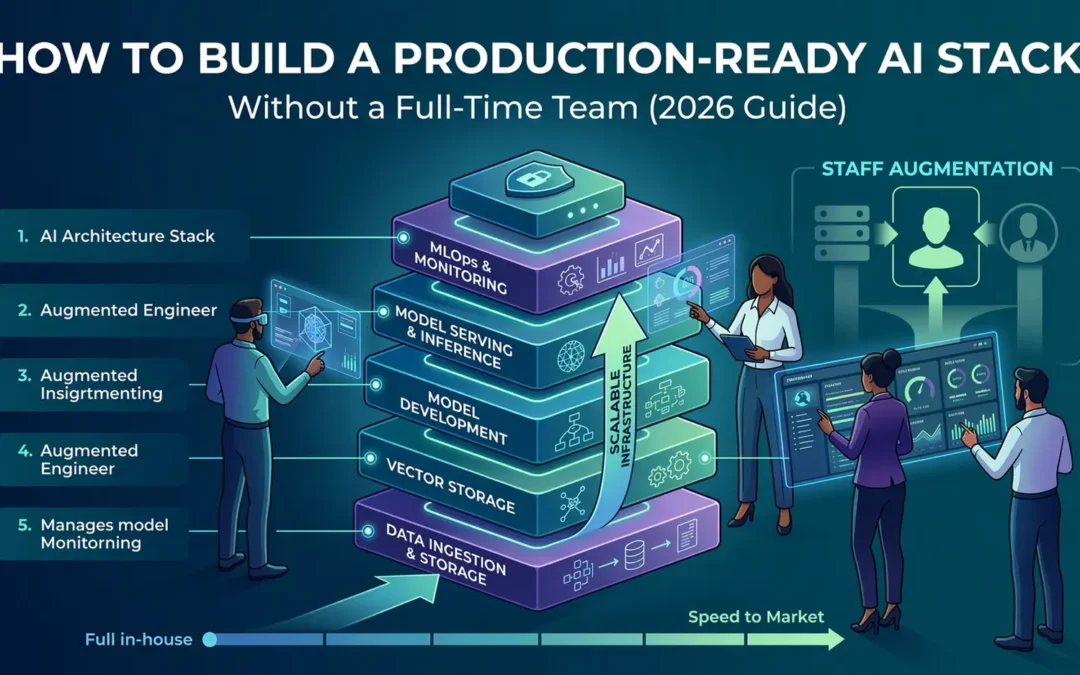
The 6-Layer AI Stack Architecture for Lean Teams
Think of your AI stack in layers. Each layer has managed service options that eliminate the need for a dedicated full-time hire in that domain — until you reach a scale that justifies it.
Layer 1: Data Ingestion & Storage
Your AI system is only as good as the data flowing into it. For lean teams, the goal is a managed pipeline that requires minimal ongoing engineering.
- Recommended tools: Fivetran, Airbyte (open-source), or AWS Glue for ETL
- Storage: Snowflake, BigQuery, or AWS S3 + Athena for cost-efficient querying
- Staff augmentation trigger: When pipeline complexity grows beyond 10+ sources or requires real-time streaming (Kafka, Flink), bring in a fractional Data Engineer for 1–3 months
Layer 2: Feature Engineering & Vector Storage
For LLM-based applications, you need a vector database. For classical ML, feature stores add consistency between training and serving environments.
- Recommended tools: Pinecone, Weaviate, or Qdrant for vector search
- Feature store: Feast (open-source) or Tecton for teams needing training-serving consistency
- Staff augmentation trigger: RAG pipelines with complex chunking, embedding strategies, or hybrid search require an LLM Engineer with hands-on RAG experience
Layer 3: Model Development & Fine-Tuning
In 2026, most lean teams should not be training foundation models from scratch. The ROI is not there unless you are operating at hyperscaler scale.
- Use foundation models via API: OpenAI GPT-4o, Anthropic Claude, Google Gemini
- Fine-tuning layer: Use managed fine-tuning services (OpenAI fine-tuning API, AWS Bedrock) only when base model performance is insufficient
- Experiment tracking: MLflow (open-source) or Weights & Biases
- Staff augmentation trigger: Domain-specific fine-tuning, RLHF, or custom architecture work requires a senior Generative AI Engineer on a project basis
Layer 4: Model Serving & Inference
This is where most teams over-engineer. They build custom serving infrastructure when managed options cover 90% of use cases at lower cost.
- Managed inference: AWS SageMaker, Google Vertex AI, or Modal for serverless GPU inference
- API gateway: Kong or AWS API Gateway for rate limiting, authentication, and routing
- Latency optimization: Consider caching layers (Redis, Momento) for high-frequency inference workloads
- Staff augmentation trigger: Sub-50ms latency requirements, custom CUDA kernels, or multi-model orchestration require a specialized ML Infrastructure Engineer
Layer 5: MLOps & Monitoring
Production AI without monitoring is not production AI. Model drift, data drift, and silent failures are the leading causes of AI system degradation in live environments.
- CI/CD for ML: GitHub Actions + DVC for model versioning and deployment pipelines
- Monitoring: Arize AI, WhyLabs, or Evidently AI for real-time drift detection
- Alerting: PagerDuty or OpsGenie integrated with your model monitoring layer
- Staff augmentation trigger: When you need to build or maintain a full MLOps platform, a fractional MLOps Engineer delivers far more ROI than a full-time hire at an early stage
Layer 6: Security, Compliance & Governance
In regulated industries — finance, healthcare, legal — this layer is non-negotiable from day one. In unregulated sectors, it becomes critical once you have real user data flowing through your system.
- Data governance: Apache Atlas or cloud-native solutions (AWS Lake Formation)
- PII handling: Presidio (open-source) for automatic PII detection and anonymization
- AI governance: Emerging tools like Credo AI or Arthur for bias monitoring and model cards
- Staff augmentation trigger: Compliance requirements (SOC 2, HIPAA, GDPR) often require an AI Governance Specialist — a role that has seen 3x demand growth in 2026
| Stack Layer | Best Managed Tool (2026) | When to Augment |
| Data Ingestion | Fivetran / Airbyte | 10+ sources or real-time streaming |
| Vector Storage | Pinecone / Weaviate | Complex RAG or hybrid search |
| Model Development | OpenAI API / AWS Bedrock | Domain fine-tuning or custom architecture |
| Inference / Serving | SageMaker / Modal | Sub-50ms latency or multi-model routing |
| MLOps & Monitoring | Arize AI / Evidently AI | Building or maintaining ML platform |
| Governance | Presidio / Credo AI | Regulated industries or SOC 2 / HIPAA |
The Staff Augmentation Model: Filling Gaps Without Full-Time Overhead
The strategic insight most CTOs miss: production-ready AI does not require full-time AI engineers. It requires the right expertise at the right layer, at the right time.
Staff augmentation gives you access to senior AI engineers — LLM Engineers, MLOps specialists, Data Engineers, AI Governance experts — on a project or retainer basis. You get production-grade output without the 6-month hiring cycle, equity dilution, or $180,000+ annual salary commitment.
| 2026 Data Point
The global AI talent gap now stands at 3.2:1 — demand outpaces supply by more than three times. Companies using AI staff augmentation are filling critical roles 4–6x faster than those relying solely on full-time hiring. |
When to Use Staff Augmentation vs. Full-Time Hire
| Scenario | Recommended Model |
| Building a RAG pipeline for the first time | Augmented LLM Engineer (project-based, 4–8 weeks) |
| Need MLOps platform built and handed off | Augmented MLOps Engineer (project-based, 2–3 months) |
| Ongoing model monitoring & retraining | Fractional MLOps retainer (10–20 hrs/week) |
| Core AI product that drives revenue | Full-time hire — this is your competitive moat |
| Compliance & governance build-out | Augmented AI Governance Specialist (project-based) |
| Scaling inference infrastructure | Augmented ML Infrastructure Engineer (project-based) |
Cost Comparison: Full-Time Team vs. Augmented Stack
Here’s the budget reality for a startup building a production AI stack in 2026:
| Approach | Annual Cost Estimate | Time to Production |
| Full in-house team (5 specialists) | $900K – $1.2M+ | 9–18 months |
| Managed stack + full-time AI lead | $280K – $380K | 4–8 months |
| Managed stack + staff augmentation | $120K – $200K | 6–12 weeks |
The augmented model doesn’t just save money — it compresses your time-to-production by months. In a market where AI capabilities are doubling every 12–18 months, that speed advantage compounds.
Step-by-Step: Building Your Lean AI Stack
- Audit your data assets first. Before picking any tool, map what data you have, where it lives, and what format it’s in. Most AI project failures trace back to data quality problems that were invisible at the design stage.
- Choose managed over custom at every layer. Until you have 10M+ inferences per month or highly specialized requirements, managed services will cost you less in engineering time than building custom infrastructure.
- Start with one model, one use case. Resist the urge to build a multi-model orchestration system on day one. Ship one AI feature to production, monitor it, and learn before expanding.
- Instrument everything from day one. Add monitoring at the inference layer before you launch, not after. Retrofitting observability into a live system is 10x harder.
- Identify your augmentation needs early. Map which layers require expertise you don’t have in-house. Engaging a staff augmentation partner with a 2–3 month lead time means you won’t be blocked when you need it.
- Build a handoff-ready architecture. If you use augmented engineers to build a layer, document it and structure the engagement so your internal team can own it at the end.
Common Mistakes That Kill Production Readiness
- Over-engineering the data pipeline before product-market fit: Start with batch processing; move to streaming when the business case is proven.
- Skipping model versioning: Every model change needs a version. Without this, debugging production failures becomes nearly impossible.
- Treating AI monitoring like software monitoring: AI systems degrade differently from traditional software. Accuracy and drift metrics require specialized monitoring tools.
- Hiring a full team before architecture is defined: Every senior AI hire you make before your architecture is stable will spend 60% of their time rearchitecting rather than shipping.
- Ignoring latency until launch: Define your latency budget at the design stage, not after users complain.
The Divogue Advantage: Vetted AI Engineers, On Demand
Divogue specializes in connecting companies with pre-vetted, senior AI engineers — LLM Engineers, MLOps specialists, Generative AI Engineers, Data Engineers, and AI Governance experts — available for project-based, fractional, or long-term augmentation engagements.
Our engineers have shipped production AI systems across fintech, healthtech, retail, and SaaS. They understand managed stack architecture, hand off clean documentation, and integrate with your existing team within days — not months.
Whether you need to build your RAG pipeline, set up MLOps monitoring, or architect your inference layer, Divogue has the specialist you need — without the 6-month hiring cycle.
| Ready to build your production AI stack?
Visit divogue.net to scope your engagement and get matched with a vetted AI engineer within 24 hours. |
Frequently Asked Questions
Can a small team realistically run a production AI system?
Yes. With managed cloud AI services, pre-built MLOps tools, and targeted staff augmentation, teams of 2–5 engineers are running production AI systems serving millions of users in 2026. The key is architectural discipline — managed over custom, and augmented expertise over premature full-time hires.
What is the minimum viable AI stack for a startup?
At minimum: a managed data pipeline (Fivetran or Airbyte), a foundation model API (OpenAI or Anthropic), a vector database (Pinecone or Weaviate), basic model monitoring (Evidently AI), and a CI/CD pipeline for model deployment. This stack can be built and production-deployed in 4–8 weeks with the right augmented engineering support.
When should I start hiring full-time AI engineers?
When your core AI capability becomes a primary revenue driver and requires continuous iteration, a full-time hire is justified. Before that point, staff augmentation consistently delivers faster results at lower cost. A common milestone is $1M ARR or 100K+ daily active users interacting with AI features.
What is AI staff augmentation?
AI staff augmentation means embedding pre-vetted, senior AI engineers into your team on a flexible basis — project, fractional, or long-term contract — without the overhead of full-time employment. It gives you production-grade expertise on demand, with a typical onboarding time of 24–72 hours through specialized partners like Divogue.
How does Divogue vet its AI engineers?
Divogue’s vetting process includes technical assessments across LLMs, MLOps, cloud infrastructure, and system design, combined with reference checks and live coding evaluations. Only the top 5% of applicants are accepted into the network — ensuring every augmented engineer meets a senior production standard.
Published by Divogue | divogue.net | April 2026 | Linekdin
AI Engineer Staff Augmentation | info@divogue.net | +1 (818) 693 2325