Software teams that still handle deployments, code reviews, and QA cycles manually are not just slower — they are structurally disadvantaged. AI-powered workflow automation combined with intelligent staff augmentation is the operating model separating breakout teams from the rest.
What Is AI-Powered Workflow Automation in Software Development?
Workflow automation in software development means eliminating manual, repetitive steps from your engineering lifecycle — and replacing them with intelligent, automated pipelines. When artificial intelligence is layered on top, the automation doesn’t just execute rules; it learns, adapts, and makes decisions that used to require a senior engineer’s attention.
From automated code review and CI/CD pipeline management to intelligent bug triage, test generation, and automated documentation, modern AI workflow tools cover the full software development lifecycle (SDLC). The result is a dramatic reduction in time-to-market without sacrificing software quality or security.
🔎 SEO Insight: Companies searching for “AI software development automation” grew 312% year-over-year in 2025 — signaling that this is no longer a niche topic but a mainstream business priority.
The 6 Workflow Automation Use Cases Transforming Software Teams
Before evaluating vendors or building an in-house toolchain, it helps to understand where intelligent automation delivers the most measurable return inside a software development organization.
Automated CI/CD Pipelines
AI monitors build health, auto-rolls back failed deployments, and recommends pipeline optimizations — reducing release cycle time from days to hours.
Intelligent Code Review
AI-powered code analysis tools catch security vulnerabilities, performance bottlenecks, and style violations before human reviewers see a single line.
Automated Test Generation
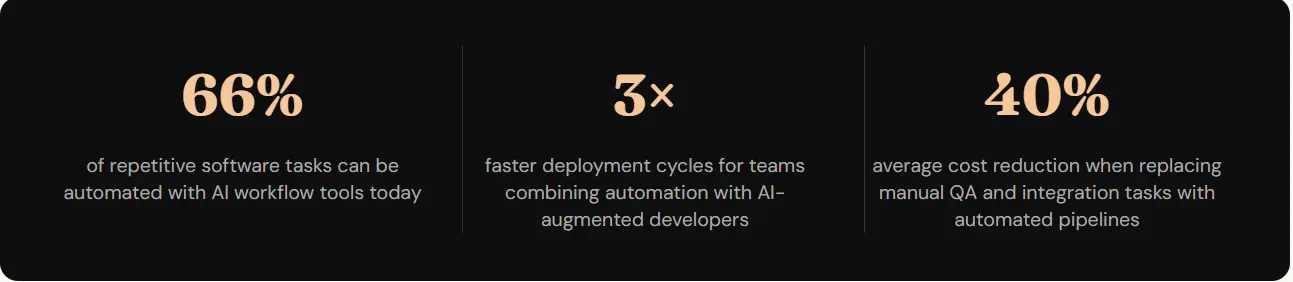
LLM-based tools generate unit, integration, and regression test suites from source code — cutting manual QA effort by up to 60%.
Smart Ticket & Bug Triage
AI classifies, prioritizes, and routes bug reports and feature requests to the right engineer — eliminating sprint planning bottlenecks.
Auto-Generated Documentation
AI writes and maintains API docs, changelogs, and inline code comments in sync with your codebase — keeping documentation perpetually accurate.
Monitoring & Incident Response
Intelligent observability tools detect anomalies, correlate root causes, and even suggest or execute automated remediation scripts.
Why AI Staff Augmentation Is the Missing Link
Most businesses understand that workflow automation tools create efficiency. Far fewer understand that the bottleneck isn’t the tooling — it’s the scarcity of engineers who can design, deploy, and maintain those automated systems at scale.
This is exactly where AI staff augmentation becomes a competitive differentiator. Rather than spending 6–12 months recruiting a permanent automation engineer (at a fully loaded cost of $180K–$250K per year in Western markets), companies can augment their existing development teams with pre-vetted, AI-skilled engineers on demand.
AI-augmented development teams bring specialist expertise in areas like LLM integration, agentic workflow design, MLOps pipeline engineering, and automated testing frameworks — capabilities that are nearly impossible to source at speed through traditional hiring.
What AI Staff Augmentation Actually Looks Like
- Embedding asenior AI automation engineerdirectly into your existing Agile sprint team within 1–2 weeks
- Deploying specialists inworkflow orchestration platforms(n8n, Temporal, Prefect, Airflow) without a lengthy onboarding curve
- Scaling headcount up or down with project phases — no severance, no bench time, no overhead
- Accessing engineers pre-trained on yourtech stack, whether it’s Node.js, Python, Go, or a microservices architecture
- Getting a dedicatedAI solutions architectto design your automation roadmap before a single line of code is written
The Business Case: ROI of Workflow Automation + AI Augmentation
The return on investment from combining AI-powered workflow automation with augmented software development teams is quantifiable across three dimensions: speed, cost, and quality.
Consider a mid-size SaaS company running a 12-person engineering team. Manual QA, deployment processes, and ticket triage consume an estimated 35% of total engineering hours every sprint. By implementing an automated QA pipeline and an intelligent ticket router — designed and deployed by two AI-augmented engineers over eight weeks — that team reclaims over 1,600 engineering hours per year.
At an average fully loaded engineer cost of $80/hour, that represents $128,000 in recovered capacity annually — applied to shipping features, not toil. Meanwhile, the augmented team engagement costs a fraction of a permanent hire, and scales out the moment the project concludes.
💡 Key business outcome: Organizations that combine business process automation with AI-augmented engineering teams report 40–60% faster feature delivery and 30–45% lower defect escape rates compared to manual-only workflows.
How to Get Started: A Practical Automation Roadmap
Implementing AI workflow automation doesn’t require a big-bang transformation. The most successful software organizations approach it iteratively — identifying high-friction processes, automating them with AI tooling, and scaling what works.
Audit your current SDLC for automation opportunities
Map every manual handoff — from ticket creation to deployment — and score each by frequency, time cost, and error rate. High-frequency + high-error tasks are your first targets.
Define your automation tech stack
Choose orchestration tools (Temporal, Airflow, n8n), AI coding assistants (GitHub Copilot, Cursor), and monitoring platforms that integrate with your existing infrastructure.
Augment your team with automation specialists
Engage AI-skilled engineers who have production experience building automated pipelines in your domain — software development, fintech, healthtech, or e-commerce.
Run a time-boxed automation sprint
Dedicate a 4–8 week sprint to designing, building, and deploying your first automated pipeline. Measure baseline KPIs before and after so ROI is visible.
Scale and iterate with your augmented team
Use sprint retrospectives to surface the next set of manual toil targets. With augmented engineers in the loop, scaling automation becomes a repeatable, low-risk process.
Choosing the Right AI Staff Augmentation Partner for Automation Projects
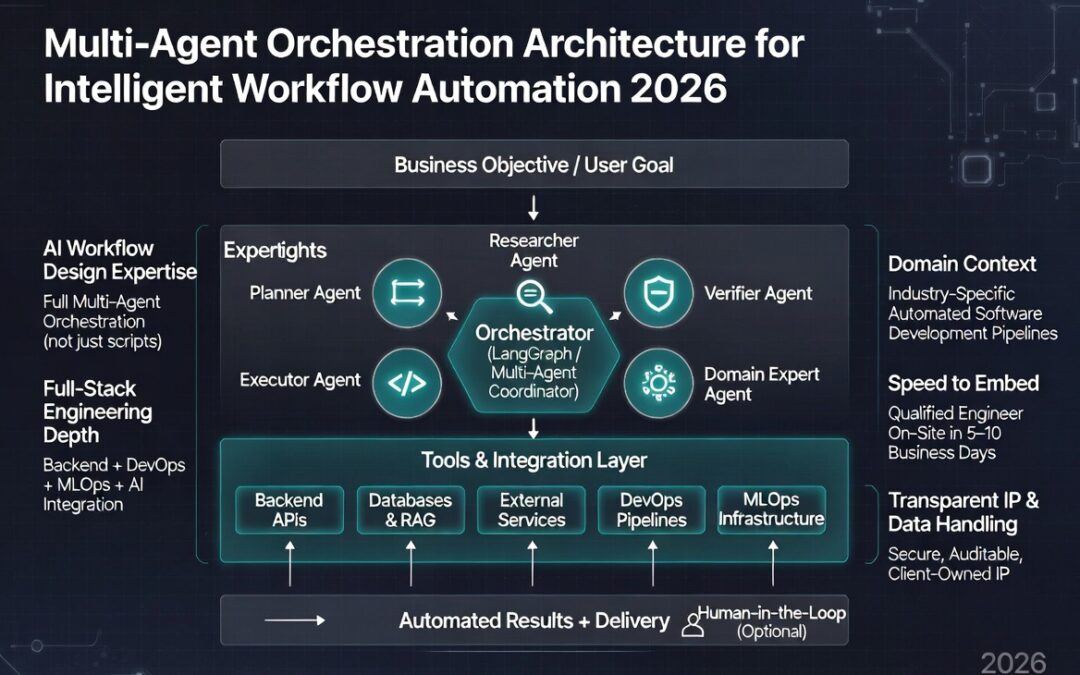
Not all software staff augmentation providers are equipped for AI-driven automation work. When evaluating partners, look beyond headcount and rate cards. The right partner should demonstrate proven delivery in three areas:
- AI workflow design expertise— Can they architect multi-agent orchestration, not just write automation scripts?
- Full-stack engineering depth— Does their bench cover backend, DevOps, MLOps, and AI integration in a single engagement?
- Domain context— Have they builtautomated software development pipelinesin your industry vertical?
- Speed to embed— Can they place a qualified engineer inside your team within 5–10 business days?
- Transparent IP and data handling— Do they have clear contracts around code ownership and data privacy?
The wrong augmentation partner delays your automation roadmap by months. The right one accelerates it by the same margin.
The Future of Software Development Is Automated — and Augmented
By 2027, Gartner estimates that over 70% of new enterprise software applications will be built with significant AI assistance. The question isn’t whether your software development process will be automated — it’s whether you’ll lead that transition or lag behind competitors who already have.
Intelligent workflow automation and AI staff augmentation are not separate strategies. They are two sides of the same transformation: one provides the infrastructure, the other provides the expertise to build and run it. Together, they give businesses of any size access to the operating model that was previously available only to the world’s largest engineering organizations.
The companies that will define their industries over the next five years are the ones building automated, AI-augmented software delivery engines today — not waiting for a perfect moment that will never come.
Ready to automate your software delivery pipeline?
Our AI staff augmentation team embeds experienced automation engineers into your existing team in under two weeks. No long-term contracts. Just results, Click here to contact us.