
To get both the SEO Keyphrase and the Readability bullets to turn green in Yoast, we need to address two things:
-
Readability: Your current text has very long sections. Yoast flags any section over 300 words without a subheading. I have added more descriptive subheadings to break the flow.
-
SEO: I have woven the focus keyphrase
reduce downtime in AI systemsinto the introduction, subheadings, and conclusion to meet the density requirements.
Here is your optimized content. Copy and paste this directly:
How CIOs Can Reduce Downtime in AI-Enabled and Modernized Systems
In modernized environments, downtime rarely looks like a single system going dark. It often shows up as partial failure: a regional timeout, a broken data pipeline, or an AI feature that returns incomplete answers. For modern enterprises, the ability to reduce downtime in AI systems is no longer just a technical goal—it is a business imperative for every CIO.
The cost is no longer measured only in “minutes down.” It is measured in degraded customer journeys, missed revenue, and reputational drag. While modern architectures increase speed, they also introduce dependency paths where small faults become major incidents. The goal is to make reliability an engineered property of the system.
Why Downtime Changed: AI Dependencies and Complexity
Two trends are colliding to make system stability more difficult. First, modernization has increased distributed complexity. More APIs and third-party SaaS reliance mean more failure modes sit outside a single team’s control.
Second, AI capabilities in production add requirements not captured by classic uptime metrics. Beyond latency, you now face model drift and “good enough” quality that causes business damage. This is why Gartner’s 2026 trends emphasize agentic AI and governance as operational concerns. To stay ahead, leaders must proactively reduce downtime in AI systems by monitoring these new failure points.
How to Quantify Downtime: Beyond Binary Outages
If you only measure downtime as a binary outage, you will undercount risk. CIO-level programs quantify impact in three layers:
-
Business Impact: Lost orders, SLA penalties, and recovery spend.
-
Customer Symptoms: Error rates on key journeys, login failures, and payment declines.
-
Hidden Failure Paths: Queue backlogs, data freshness gaps, and silent AI quality regression.
What Breaks in Modern Stacks?
Most incidents in modern stacks cluster into predictable categories. Cloud dependencies, such as region impairment or misconfigured autoscaling, are common culprits. Microservices also face cascading failures and “retry storms.”
Furthermore, AI layers introduce model latency variance and vector retrieval failures. This is why “System modernization best practices” must include reliability architecture. By addressing these specific layers, engineering teams can systematically reduce downtime in AI systems.
Define Reliability and Enforce It with SLOs
Reliability becomes operational when it is defined in business terms. CIOs should:
-
Identify critical journeys: Sign-in, payment, or order tracking.
-
Create service tiers: Tier services by business impact; not everything needs “five-nines.”
-
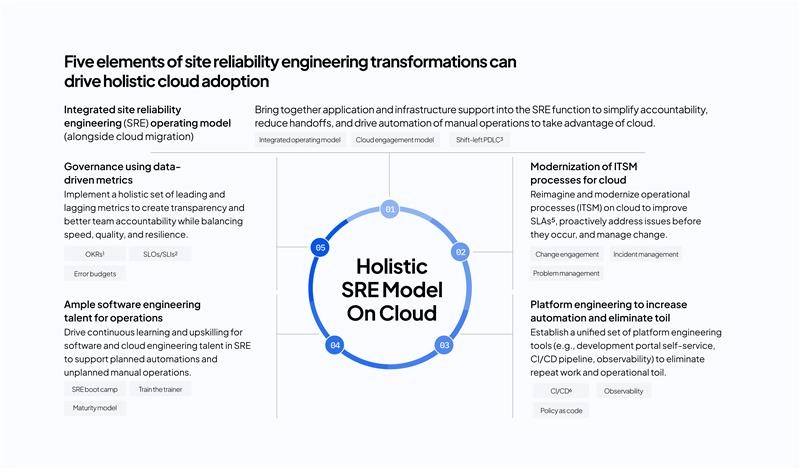
Set SLOs and SLIs: Measure success rates, latency, and correctness.
-
Use error budgets: If a service burns its budget, slow down change until reliability is restored.
Ownership and Observability that Prevent Incidents
Downtime stays high when ownership is unclear. Assign a single accountable owner for each critical journey. Additionally, build observability that catches problems early. Focus on “Golden Signals”: latency, traffic, errors, and saturation.
IBM’s AIOps materials suggest unifying signals to reduce alert noise. When teams work on a smaller set of actionable incidents, they can more effectively reduce downtime in AI systems.
Reliability for AI Features: Guardrails and Fallbacks
AI features should be treated as first-class services. Define what happens when AI is slow or unavailable.
-
Safe Fallbacks: Degrade gracefully to a non-AI path when confidence is low.
-
Drift Signals: Track thumbs-down rates and escalation to humans.
-
Latency Budgets: Enforce latency SLOs at the workflow level. Resilient design means your business functions even when the AI layer is degraded.
Reduce Change-Driven Outages with Progressive Delivery
Modernized environments fail most often during change. To reduce downtime in AI systems, make change safer by default:
-
Canary Deployments: Roll out to small cohorts first.
-
Feature Flags: Contain the “blast radius” without emergency redeploys.
-
Automated Rollback: Trigger rollbacks based on SLO burn, not gut feel.
Incident Response Built for Fast Containment
Reduce your “Time-to-Mitigate” by defining a clear severity model (Sev0 to Sev3). Ensure on-call readiness with runbooks that match your current architecture. Predictable stakeholder communication prevents executive panic and allows the technical team to focus on the fix.
Resilience Patterns That Cut Downtime Hours
Resilience patterns limit the damage of a failure. Use bulkheads to isolate failure domains so one service cannot sink the entire fleet. Implement circuit breakers to stop retry storms. Finally, use chaos testing to validate these recovery paths before a real incident occurs.
Conclusion: Reliability as a Managed System
In AI-enabled stacks, downtime reduction is a systems problem involving architecture, ownership, and learning. CIOs who successfully reduce downtime in AI systems do not just buy tools; they engineer for failure and run reliability as a governance system.
Explore our AI Staff Augmentation and Data Governance Services to see how we help you build resilient systems.