By Divogue Team | April 2026 | 12 min read | AI Hiring & Talent Strategy
| 📌 Quick Summary: The global AI talent gap is structural and widening. Companies that move fast — with the right vetting frameworks and hiring channels — are securing the best AI engineers. This playbook covers exactly how to do it. |
The AI Talent War Is Already Happening — Are You Winning?
Every forward-thinking company today is racing to build AI capabilities. But here is the uncomfortable truth: there are simply not enough qualified AI engineers to go around. According to industry data, only 205 AI PhDs were awarded in the United States in a single recent year — and over half of all AI master’s and doctoral degrees earned in the US were earned by international students, making the pipeline heavily dependent on immigration policy.
Meanwhile, AI-related job postings have surged dramatically while overall global hiring remains below pre-pandemic levels. This divergence is not cyclical — it is structural. And it means the companies that figure out how to hire AI engineers faster, smarter, and more efficiently will have an insurmountable competitive advantage in the years ahead.
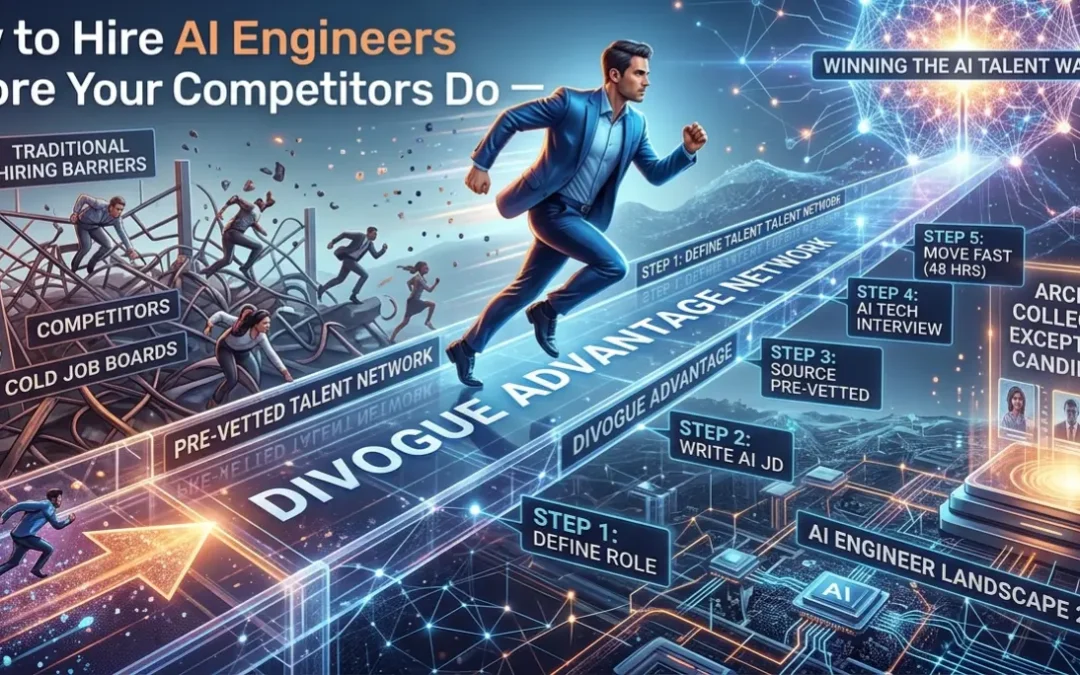
This 2026 playbook gives you the exact frameworks, platforms, vetting techniques, and sourcing strategies you need to hire top AI engineers — before your competitors hire AI engineers in 2026.
1. Understand the AI Engineer Landscape in 2026
The roles driving the most demand right now
Not all AI engineers are the same. In 2026, the most in-demand AI and machine learning roles fall into five distinct categories. Understanding these clearly is the first step toward hiring effectively:
- AI/ML Engineers — Build and train machine learning models, design neural network architectures, and deploy AI systems into production environments.
- MLOps Engineers — Manage the full lifecycle of ML models — from training pipelines to monitoring in production. This is the fastest-rising AI role in 2026, yet the least understood by hiring managers.
- Forward-Deployed Engineers — A newer category: engineers embedded directly within client organizations to customize and deploy AI solutions in real-world settings.
- AI Governance & Ethics Specialists — Driven by EU AI Act compliance obligations beginning in August 2026, this is one of the fastest-growing categories in enterprise AI hiring.
- Computer Vision Engineers — Specialists who build real-time video analytics, object detection systems, and visual AI models. Rare, highly paid, and in massive demand across manufacturing, healthcare, and autonomous systems.
| ⚡ Key Insight: The focus has shifted from general data science toward production-ready and governance-focused profiles. If your job description is still asking for a generic ‘data scientist,’ you are already behind. |
What does a senior AI engineer actually cost in 2026?
Salary transparency helps you move faster and set realistic expectations. Here is what the market looks like for senior AI engineering talent in 2026:
| Role | US Market (Annual) | Via Remote/Augmentation |
| AI/ML Engineer | $160K – $220K | $80K – $120K |
| MLOps Engineer | $150K – $200K | $70K – $110K |
| Computer Vision Engineer | $180K – $240K | $90K – $130K |
| AI Governance Specialist | $140K – $190K | $65K – $100K |
| Forward-Deployed Engineer | $170K – $230K | $85K – $125K |
Note: Remote and staff augmentation models can reduce AI hiring costs by up to 50% while maintaining top-tier engineering quality.
2. Why Traditional Hiring Fails for AI Engineers
Most companies approach AI engineer hiring the same way they hire software developers. This is a critical mistake. Here is why:
- The talent pool is tiny. The global supply of production-ready AI engineers is a fraction of the demand. Generic job boards surface the same under-qualified profiles that everyone else is seeing.
- AI skills have a short shelf life. The skills required to work in AI today look meaningfully different from what was sufficient even two years ago. A resume that looks great on paper may represent outdated knowledge.
- Interviews designed for software engineers don’t work. Asking AI engineers to solve LeetCode problems or reverse a binary tree tells you nothing about their ability to build, train, and deploy models in production.
- Time-to-hire is too slow. A typical corporate hiring process takes 6 to 10 weeks. The best AI engineers are gone in days. By the time you schedule a second interview, your top candidate has already accepted an offer elsewhere.
- Internal recruiters lack AI domain knowledge. Evaluating whether a candidate truly understands transformer architectures, RAG pipelines, or MLOps workflows requires technical depth that most HR teams simply don’t have.
| 💡 The Solution: The companies winning the AI talent war are not posting on LinkedIn and hoping. They are using pre-vetted talent networks, structured technical evaluation frameworks, and flexible hiring models that move 3x faster than traditional recruiting. |
3. The 5-Step Framework to Hire AI Engineers Fast
Step 1: Define the role with production-readiness in mind
Before you post a single job description, answer these five questions:
- Is this a model-building role, a deployment/MLOps role, or a governance role?
- Does the engineer need to work with LLMs, computer vision, reinforcement learning, or classical ML?
- What cloud infrastructure will they use — AWS SageMaker, Google Vertex AI, Azure ML?
- Is this a build-from-scratch project or integration with existing ML pipelines?
- What is your timeline — immediate delivery, 6-month project, or long-term team expansion?
These answers dictate whether you need a full-time hire, a staff augmentation contract, or a project-based specialist. Confusing these three fundamentally different needs is one of the top reasons AI hiring fails.
Step 2: Write an AI-specific job description that attracts top 1% talent
Vague job descriptions get vague candidates. Elite AI engineers are selective — they self-filter based on the quality of your job post. Here is what high-performing AI job descriptions include:
- Specific tech stack: PyTorch or TensorFlow? LangChain or LlamaIndex? AWS or GCP? Name the exact tools.
- Real problem statement: ‘Build an ML pipeline for real-time fraud detection on 50M daily transactions’ is better than ‘work on exciting AI projects.’
- Model deployment context: Are models deployed on-device, in the cloud, or at the edge? This is critical for senior engineers.
- Data scale: Mention the volume of data involved. ‘TB-scale datasets’ signals a serious role.
- Equity and flexibility: Top AI engineers have options. Remote flexibility and equity are non-negotiable differentiators.
Step 3: Source from pre-vetted AI talent networks — not cold job boards
This is the single biggest leverage point. General platforms like LinkedIn or Indeed require you to screen hundreds of applications to find one qualified candidate. Pre-vetted AI talent networks have already done that work.
What to look for in an AI talent network:
- A rigorous technical screening process that includes AI/ML-specific assessments (not just coding tests)
- Reference checks from previous ML and AI projects specifically
- Candidates who have deployed models to production — not just built proof-of-concepts
- Global talent coverage — Latin America, Eastern Europe, and Asia-Pacific have exceptional AI talent at significantly lower cost
- Turnaround time of 24 to 72 hours for vetted candidate shortlists
| 🌍 Divogue Advantage: Divogue’s pre-vetted AI engineer network spans North America, Latin America, Europe, and Asia-Pacific — with a 24-hour match guarantee and costs up to 50% below US market rates. You can hire pre-vetted AI engineers in under 14 days. |
Step 4: Conduct a structured 45-minute AI technical interview
Replace generic coding tests with a structured technical evaluation designed specifically for AI engineers. A well-designed 45-minute interview covers three zones:
- Zone 1 — Foundational AI Knowledge (15 min): Ask candidates to explain the architecture behind a transformer model, describe the bias-variance tradeoff, and explain how they would approach data leakage in a production ML system.
- Zone 2 — System Design (20 min): Present a real-world scenario: ‘You need to build a recommendation engine for an e-commerce platform with 10 million users and 1 million SKUs. Walk me through your approach.’ Evaluate thinking, not just answers.
- Zone 3 — Production Experience (10 min): Ask about the most complex model they have deployed to production — what went wrong, how they monitored it, and how they handled model drift. This separates engineers with real experience from those with only academic backgrounds.
Step 5: Move fast — make a decision within 48 hours of final interview
The top 1% of AI engineers are interviewing at three to five companies simultaneously. The companies that move the fastest win. Here is how to compress your decision timeline:
- Align your technical interviewer and hiring manager before the interview — not after.
- Define your go/no-go criteria before the interview begins.
- Have a pre-approved offer range ready, so compensation negotiation does not stall a great hire.
- Send the offer within 24 hours of the final interview, not 5 business days.
- Assign a technical onboarding buddy on day one to accelerate ramp-up time.
4. Staff Augmentation vs. Full-Time Hire: Which Model Wins in 2026?
This is the strategic question every CTO is asking in 2026. The answer depends on your AI roadmap phase:
| Criteria | Staff Augmentation | Full-Time Hire |
| Time to hire | 24–72 hours | 4–10 weeks |
| Cost | Up to 50% lower | Higher (+ benefits) |
| Flexibility | Scale up/down quickly | Fixed headcount |
| Best for | Phases, sprints, PoCs | Core long-term team |
| Domain depth | High (pre-vetted) | Varies by sourcing |
| Compliance risk | Managed by partner | Employer of record |
For most companies in 2026, a hybrid model works best: a small core of full-time senior AI engineers who own architecture decisions, supported by a flexible ring of augmented specialists for specific project phases, model types, or compliance requirements.
5. Common Mistakes That Cost You the Best AI Talent
- Waiting for the ‘perfect’ candidate: In a market this tight, the engineer who checks 8 out of 10 criteria and has genuine production experience will outperform the theoretical perfect hire who doesn’t exist.
- Over-indexing on academic credentials: A self-taught ML engineer with 3 deployed production models is more valuable than a PhD candidate who has never shipped to production.
- Offering below-market compensation and hiding it: AI engineers talk. If your offer is not competitive, they will not just decline — they will tell others.
- Multi-round interview processes with 6+ stages: Every extra interview stage costs you candidates. Top AI engineers will simply withdraw and accept a faster offer elsewhere.
- Ignoring timezone and collaboration fit: A brilliant AI engineer 12 time zones away who is never online during your team’s working hours will struggle to deliver in a collaborative environment. Hire for overlap, not just skill.
6. How to Retain AI Engineers Once You Have Hired Them
Hiring is only half the battle. AI engineers have some of the highest market mobility of any technical role. Here is how to keep your best people:
- Give them real problems to solve: AI engineers leave when they are maintaining legacy systems instead of building. Keep them on frontier work.
- Invest in compute: Nothing kills an AI engineer’s productivity faster than insufficient GPU access or data infrastructure. Budget for proper tooling.
- Allow research time: Top AI engineers want to stay current. Allocating 10% to 20% of time for learning, conferences, and internal research significantly increases retention.
- Publish their work: Blog posts, open-source contributions, and conference talks attract more AI talent and give your engineers the professional recognition they value.
- Create clear technical career ladders: AI engineers should not be forced into management to advance. A Principal ML Engineer track is as valuable as a VP of Engineering track.
7. Why Companies Choose Divogue to Hire AI Engineers
Divogue is not a job board. We are an AI-specialized talent partner that pre-vets, matches, and supports elite AI engineers from across the globe.
- 24-hour match guarantee: Receive a shortlist of pre-vetted, production-ready AI engineer profiles within one business day.
- Top 1% screening: Every candidate passes technical AI/ML assessments, code reviews, and reference checks before reaching you.
- Global network: Access talent from North America, Latin America, Eastern Europe, and Asia-Pacific — the regions producing the best AI engineers at the most competitive rates.
- Up to 50% cost reduction: Hire senior-level AI engineers at a fraction of the cost of equivalent US-based talent, without sacrificing quality.
- Ongoing support: We do not disappear after placement. Every engagement includes quality assurance and ongoing support from the Divogue team.
| 🚀 Ready to hire? Hire pre-vetted AI engineers or email Freddie@divogue.net to get your first shortlist within 24 hours. |
Conclusion: Speed + Quality = Competitive Advantage
In 2026, the ability to hire elite AI engineers quickly and cost-effectively is one of the most important competitive advantages a technology company can have. The companies that are winning are not spending 10 weeks on LinkedIn — they are using purpose-built AI talent networks, structured vetting frameworks, and flexible hiring models to move 3x faster than the market.
The AI talent war will not slow down. The structural supply shortage is not going away. But the companies that build a repeatable, fast, and high-quality AI hiring process today will compound that advantage for years to come.
The question is not whether your competitors are racing to hire the best AI engineers. They are. The question is whether you will get there first.
Frequently Asked Questions
How long does it take to hire an AI engineer in 2026?
With a traditional hiring process, expect 4 to 10 weeks. Using a pre-vetted AI talent platform like Divogue, you can receive qualified candidates within 24 hours and make a hire within 3 to 7 days.
What is the difference between an AI engineer and a data scientist?
Data scientists focus on analysis, experimentation, and insights from data. AI engineers focus on building, deploying, and maintaining machine learning systems in production. In 2026, the demand is heavily weighted toward engineers who can ship production-ready AI — not just build notebooks.
How do I evaluate AI engineers without an internal ML team?
Use a structured technical interview framework focused on production experience (as outlined in Step 4 of this playbook), or partner with a specialist AI talent firm that can conduct technical vetting on your behalf.
Is offshore AI talent as good as US-based talent?
Yes — when properly pre-vetted. The best AI engineers from Latin America, Eastern Europe, and Asia-Pacific have trained on the same models, frameworks, and research as their US counterparts. The key is a rigorous vetting process, which is exactly what Divogue provides.
What is AI staff augmentation?
AI staff augmentation means integrating pre-vetted external AI engineers into your team on a contract or project basis, without the overhead of full-time employment. It is the fastest-growing AI hiring model in 2026 because it aligns with the phased nature of AI development — scaling up for model deployment, scaling down during maintenance cycles.
Published by Divogue | divogue.net | Freddie@divogue.net | +1 818-693-2325 | Linkedin