By Divogue Editorial Team · April 2026 · 12 min read · AI Hiring & Emerging Roles
| Key Stat
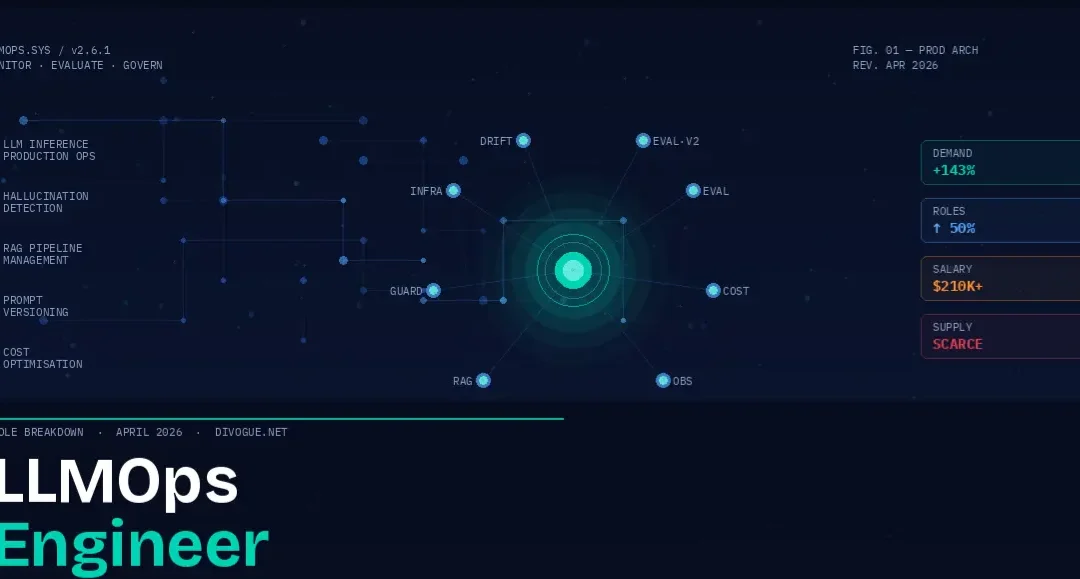
LLMOps is now a standard part of AI delivery. In 2026, organisations are no longer asking whether to monitor and manage their large language models in production — they are asking who will do it. That person is the LLMOps engineer, and right now there are far more open roles than qualified candidates. |
Introduction: The Role Nobody Heard of Three Years Ago
Three years ago, if you had typed ‘LLMOps engineer’ into a job board, you would have found nothing. Today it is one of the most searched technical hiring terms of 2026 — and for good reason.
As companies move from experimenting with large language models to deploying them in real production environments, a critical gap has emerged. Training an LLM is hard. Deploying it responsibly at scale — monitoring its outputs, managing its drift, controlling its costs, governing its behaviour — is an entirely different discipline. That discipline now has a name: LLM Operations, or LLMOps.
The LLMOps engineer is the specialist who owns that discipline. They sit at the intersection of machine learning engineering, DevOps, data reliability, and AI governance. They are the reason your LLM-powered product does not hallucinate in front of your biggest enterprise client. And in 2026, they are extraordinarily difficult to hire.
This guide tells you everything you need to know: what a LLMOps engineer actually does, how this role differs from MLOps, which skills matter, what they earn, and how to find and vet one before your competitors do.
What Is LLMOps? A Plain-Language Definition
LLMOps — short for Large Language Model Operations — is the set of practices, tools, and infrastructure required to deploy, monitor, evaluate, and maintain large language models in production environments. It extends traditional MLOps principles into the specific complexities introduced by foundation models, generative AI, and agentic systems.
Where MLOps manages the lifecycle of predictive machine learning models, LLMOps handles the unique challenges that come with LLMs: non-deterministic outputs, hallucination detection, prompt injection risks, context window management, retrieval-augmented generation (RAG) pipelines, real-time evaluation, and the cost implications of running billions of tokens at scale.
| LLMOps vs MLOps: the key difference
MLOps is about making predictions reliably at scale. LLMOps is about making language generation reliable, safe, cost-effective, and explainable at scale — with far higher stakes per output, since a single bad LLM response can reach your end user directly. |
What Does an LLMOps Engineer Actually Do?
The LLMOps engineer’s day-to-day work spans the full lifecycle of an LLM-powered system — from the moment a model is selected to the moment it is retired or replaced. Here is a breakdown of the core responsibilities:
1. Model deployment and infrastructure
- Select and configure LLM serving infrastructure (AWS Bedrock, Azure OpenAI Service, Google Vertex AI, or self-hosted open-source models)
- Build and maintain scalable inference pipelines that handle variable load at low latency
- Implement caching layers, load balancing, and failover logic to maintain uptime
- Optimise model serving costs — a single poorly managed LLM deployment can run six-figure monthly bills
2. Evaluation and monitoring
- Design and run automated LLM evaluation pipelines — testing outputs for accuracy, relevance, coherence, and safety
- Implement real-time hallucination detection and output scoring
- Monitor model performance drift: when an LLM’s responses degrade over time as the world changes around it
- Build dashboards tracking token usage, latency, error rates, and cost per query
3. RAG pipeline management
- Design and maintain retrieval-augmented generation (RAG) architectures — the systems that connect LLMs to live enterprise data
- Manage vector databases (Pinecone, Weaviate, Chroma) and embedding pipelines
- Tune chunking strategies, retrieval relevance, and re-ranking logic to improve answer quality
4. Prompt engineering and versioning
- Maintain a prompt library and versioning system — treating prompts with the same engineering discipline as code
- Run A/B tests on prompt variants to optimise output quality and task completion rates
- Build prompt guardrails that prevent jailbreaking, injection attacks, and policy violations
5. AI governance and compliance
- Implement content filtering, PII detection, and output moderation pipelines
- Maintain audit logs of model inputs and outputs for regulatory compliance (EU AI Act, GDPR, HIPAA)
- Document model behaviour policies and support responsible AI reviews
Why Demand for LLMOps Engineers Is Exploding in 2026
Three forces have converged to make the LLMOps engineer one of the most urgently needed profiles in technology right now.
| Driver | Impact on LLMOps Demand |
| LLMs moving from pilots to production | Every organisation that shipped a GenAI proof-of-concept in 2024–25 now needs someone to keep it running reliably. That is a massive, simultaneous transition across thousands of companies. |
| Agentic AI going mainstream | Autonomous AI agents that execute multi-step tasks dramatically increase the failure surface — a bad output in an agent loop causes cascading errors. LLMOps engineers are the safety net. |
| EU AI Act compliance obligations | High-risk AI systems must meet strict documentation, monitoring, and audit requirements from August 2026. That is infrastructure work requiring dedicated LLMOps ownership. |
| LLM cost pressure at scale | As usage scales, unmanaged LLM inference costs become a major budget line. LLMOps engineers optimise prompt efficiency, implement caching, and choose the right model tier per task. |
| Model evaluation maturing | In 2026, companies no longer accept ‘it feels right’ as a model quality standard. Rigorous benchmarking, LLMOps pipelines, and continuous evaluation are now expected. |
| Hallucination risk in enterprise | A single hallucinated response in a healthcare, legal, or financial product can have serious consequences. Production-grade LLM safety requires dedicated operational engineering. |
LLMOps vs MLOps: Do You Need Both?
This is one of the most common questions engineering leaders ask when first hearing about LLMOps. The short answer: if you are running LLMs in production, MLOps alone is not enough.
| Dimension | MLOps | LLMOps |
| Primary concern | Model accuracy and prediction drift | Output quality, safety, cost, and compliance |
| Key artefact | Trained model weights and features | Prompts, embeddings, RAG pipelines, evaluation suites |
| Evaluation method | Metrics: accuracy, precision, recall, F1 | LLM judges, human evals, automated rubrics, benchmarks |
| Failure modes | Silent prediction degradation | Hallucination, jailbreaks, PII leaks, toxic outputs |
| Key tools | MLflow, Kubeflow, SageMaker Pipelines | LangSmith, Weights & Biases, Arize Phoenix, Helicone |
| Governance needs | Model cards, bias audits | Prompt audit logs, output moderation, EU AI Act compliance |
Many organisations need both MLOps and LLMOps capabilities, but they are distinct skill sets. A strong MLOps engineer will not automatically understand RAG pipeline tuning, prompt versioning, or LLM evaluation frameworks — and vice versa.
What Skills Should You Look for When Hiring an LLMOps Engineer?
The LLMOps engineering profile is genuinely hybrid: it combines software engineering fundamentals with deep LLM knowledge, a DevOps mindset, and an understanding of responsible AI principles. Avoid two common hiring mistakes: hiring a pure DevOps engineer who has never worked with language models, and hiring an LLM researcher who has never shipped production infrastructure.
Core technical skills (non-negotiable)
- Python fluency — the lingua franca of the LLM toolchain
- Deep familiarity with LLM APIs and SDKs: OpenAI, Anthropic Claude, Google Gemini, AWS Bedrock, Azure OpenAI
- RAG architecture design: vector databases (Pinecone, Weaviate, pgvector), embedding models, chunking strategies
- LLM orchestration frameworks: LangChain, LlamaIndex, Haystack, or equivalent
- Observability and monitoring: LangSmith, Helicone, Arize Phoenix, Weights & Biases
- Cloud infrastructure: AWS, GCP, or Azure — particularly managed LLM services and serverless inference
- Containerisation and deployment: Docker, Kubernetes, CI/CD pipelines
- Prompt engineering discipline: systematic prompt versioning, A/B testing, guardrail design
Advanced skills that separate the best candidates
- LLM evaluation design: building automated evaluation pipelines using LLM-as-judge techniques and human feedback loops
- Fine-tuning experience: LoRA, QLoRA, or PEFT techniques for adapting foundation models to domain-specific tasks
- LLMOps tooling: hands-on experience with production LLMOps platforms such as LangSmith, Portkey, or Phoenix
- AI governance and compliance: EU AI Act practical knowledge, PII detection, content moderation pipelines
- Cost optimisation: model routing, token budgeting, caching architecture, and right-sizing model selection by task
- Agentic AI systems: designing oversight and failure recovery for multi-step autonomous agent workflows
LLMOps Engineer Salary Benchmarks for 2026
LLMOps is a nascent role with a genuine scarcity premium. Candidates with verifiable production LLMOps experience — not just LLM experience — command significantly higher rates than MLOps or DevOps counterparts. The following benchmarks reflect total base compensation and exclude equity.
| Experience Level | US Market (USD) | Remote / Offshore (USD) |
| Mid-level (2–4 yrs ML + 1 yr LLMOps) | $160,000 – $210,000 | $55,000 – $90,000 |
| Senior (5+ yrs ML + 2+ yrs LLMOps) | $210,000 – $280,000 | $85,000 – $130,000 |
| Staff / Principal LLMOps Engineer | $280,000 – $380,000+ | $120,000 – $180,000 |
| Contract / Staff Augmentation (per month) | $15,000 – $30,000 | $5,000 – $12,000 |
Note: AI engineers with specialised production skills command a 12% salary premium on average over their peers. For LLMOps engineers specifically, the premium is higher due to the role’s novelty and the speed at which companies need them. Budget accordingly.
Where to Find LLMOps Engineer Candidates in 2026
LLMOps engineers are not yet abundant on standard job boards. Most are currently employed, often building the LLMOps function from scratch at their current company. Passive sourcing and specialist networks are far more effective than posting a job and waiting.
Top sourcing channels
- Specialist AI staffing partners — Divogue maintains an active, pre-vetted network of senior LLM engineers and LLMOps specialists. We can surface your first shortlist within 24 hours, saving months of passive search.
- LLM community events and Discord servers — the LangChain, LlamaIndex, and Weaviate communities attract exactly the practitioners who are building in production today. The AI Engineer Summit and LLMOps.community are specific signals.
- GitHub activity — the best LLMOps engineers are contributing to or starring repositories around LangSmith, Phoenix, LiteLLM, or open-source evaluation frameworks. This is a far better signal than a resume.
- Hugging Face and ML community profiles — practitioners who publish fine-tuning experiments, share evaluation notebooks, or contribute to open evaluation benchmarks are demonstrating exactly the right skills.
- Referrals from your ML engineering team — your existing ML engineers know who the standout LLMOps practitioners are in their networks. Incentivise those referrals generously.
How to Vet an LLMOps Engineer: A Practical 4-Step Framework
This role is new enough that many candidates will overstate their experience. Production LLMOps work is distinct from LLM experimentation — your vetting process needs to expose that gap.
Step 1 — Production evidence check
Ask the candidate to walk you through a real LLM system they have run in production. Probe for: What was the scale? How did you monitor hallucinations? What happened when the model drifted? What was your cost per thousand queries, and how did you optimise it? Candidates who have truly operated LLMs in production will answer these fluently. Candidates who have only experimented will deflect or speak only in theory.
Step 2 — RAG pipeline design exercise
Give the candidate a realistic scenario: ‘You are building a RAG system for an enterprise customer support tool with 500,000 documents. Walk us through your architecture.’ Look for: chunking strategy rationale, embedding model selection, retrieval relevance tuning, re-ranking logic, and how they would evaluate answer quality. A strong LLMOps engineer will immediately start talking about trade-offs, not just tools.
Step 3 — Evaluation design challenge
Ask the candidate to design an evaluation suite for a specific LLM use case — for example, a legal document summarisation tool. Can they define what ‘good’ looks like? Can they build automated evaluation without relying solely on human review? Do they know when to use LLM-as-judge vs. rule-based checks vs. embedding similarity? This separates practitioners who think systematically from those who rely on vibes.
Step 4 — Cost and governance scenario
Present a scenario: ‘Your LLM inference costs have doubled month-over-month and your CISO has flagged that PII may be entering prompts. What do you do?’ This tests cost-optimisation instincts, observability knowledge, and security awareness simultaneously — three things every production LLMOps engineer must own.
Setting Your LLMOps Engineer Up for Success: The First 60 Days
Because LLMOps is often the first dedicated role of its kind at a company, the first 60 days need to be structured deliberately. Without a clear mandate and executive air cover, even a strong LLMOps engineer will be pulled into firefighting rather than building sustainable infrastructure.
| Phase | Focus |
| Days 1–20 (Audit & Map) | Inventory all LLM deployments, identify evaluation gaps, map current monitoring coverage, assess cost baseline |
| Days 21–40 (Instrument) | Instrument observability across live LLM products, define evaluation criteria per use case, identify the highest-risk gaps |
| Days 41–60 (Build & Govern) | Ship first automated evaluation pipeline, establish prompt versioning system, produce initial LLM governance policy |
5 Mistakes to Avoid When Hiring an LLMOps Engineer
- Confusing LLM experience with LLMOps experience. Someone who has built LLM prototypes or used the OpenAI API is not an LLMOps engineer. The role requires production operations experience, not just LLM familiarity.
- Hiring an MLOps engineer and assuming the skills transfer. MLOps and LLMOps share foundations but diverge significantly in tooling, evaluation methodology, and failure modes. Verify LLM-specific production experience directly.
- Underweighting governance and compliance skills. In 2026, any LLMOps engineer who cannot speak to EU AI Act obligations, content moderation design, or audit log architecture is a regulatory and reputational risk.
- Hiring too junior for the role. The first LLMOps engineer at a company needs to build the function from scratch. This requires seniority, autonomy, and the confidence to push back on unsafe deployment timelines.
- Leaving the mandate undefined. Without clarity on which LLM systems this person owns, what success looks like in 90 days, and who they report to, the best LLMOps engineers will leave within months.
How Divogue Helps You Hire Your LLMOps Engineer
Divogue specialises in connecting fast-scaling companies with the top 1% of AI talent globally — including the LLMOps engineers who are the hardest profiles to find in the market right now.
We do not post job ads and wait. We maintain an active, continuously refreshed network of pre-vetted senior AI engineers across North America, Europe, Latin America, and Asia-Pacific — all assessed by senior ML practitioners who understand the difference between LLM experience and production LLMOps experience.
| Why companies choose Divogue for LLMOps hiring
Shortlists delivered within 24 hours. Every candidate technically vetted by ML engineers, not generalist recruiters. Costs up to 50% lower than retained search. Two-week no-risk trial — if the engineer is not right, you pay nothing. |
We have placed AI engineers with fast-growing startups and global enterprises alike, including Riskcast Solutions, BGO Software, ATG Entertainment, and more. Our clients choose Divogue because we treat hiring as an engineering problem — systematic, fast, and rigorous.
| Ready to hire your LLMOps engineer?
Visit Divogue.net or contact us at info@divogue.net. Tell us your stack, your scale, and your timeline — and we will present your first shortlist within 24 hours. |
Frequently Asked Questions About LLMOps Engineers
Is LLMOps the same as MLOps?
No. MLOps covers the operational lifecycle of traditional machine learning models — training pipelines, feature stores, prediction serving, and model drift. LLMOps extends into the specific challenges of large language models: prompt management, RAG pipeline operations, hallucination monitoring, token cost optimisation, and LLM-specific governance. Both disciplines share infrastructure foundations, but the tools, failure modes, and evaluation methodologies are distinct.
Do I need a dedicated LLMOps engineer or can my MLOps team cover it?
If you have more than one LLM in production — or any LLM in a high-stakes use case (customer-facing, regulated industry, or agentic workflow) — you need dedicated LLMOps capability. An MLOps engineer can bridge the gap temporarily, but the specialised evaluation, prompt governance, and cost-optimisation work that LLMOps demands will quickly overwhelm a team that is also managing traditional ML pipelines.
What is the difference between an LLMOps engineer and a prompt engineer?
A prompt engineer focuses on designing and optimising the instructions given to an LLM. An LLMOps engineer builds and maintains the infrastructure that governs, monitors, and manages LLMs across their entire production lifecycle. In practice, LLMOps engineers must understand prompt engineering deeply — but they also own deployment architecture, evaluation pipelines, observability, and governance in ways that a prompt engineer typically does not.
How quickly can Divogue source an LLMOps engineer?
Divogue can deliver an initial shortlist of pre-vetted LLMOps candidates within 24 hours. Average time from first contact to offer stage is three to six weeks — compared to the four to six months typical of traditional technical search for this profile.
What tech stack should I expect an LLMOps engineer to know?
Core expectations in 2026 include: Python, LangChain or LlamaIndex, at least one major cloud LLM platform (AWS Bedrock, Azure OpenAI, or Google Vertex AI), a vector database (Pinecone, Weaviate, or pgvector), and at least one LLMOps observability tool (LangSmith, Helicone, or Arize Phoenix). Familiarity with Docker, Kubernetes, and CI/CD pipelines rounds out the infrastructure side of the role.
Conclusion: The LLMOps Engineer Is Not Optional Anymore
The shift from LLM experimentation to LLM operations is the defining technical challenge of 2026. Every organisation that has deployed a large language model is discovering the same truth: keeping it running safely, reliably, and cost-effectively in production is a full-time engineering discipline.
The LLMOps engineer is the person who owns that discipline. They are rare, in high demand, and growing harder to find with every month that passes. The companies that move fast to hire strong LLMOps talent now are building a compounding operational advantage that will be very difficult for slower competitors to close.
Whether you need a full-time LLMOps engineer or a flexible staff augmentation model, Divogue can help you find the right person in 24 hours. Visit Divogue.net to start your search today.
Published by Divogue · divogue.net · info@divogue.net · +1 (818) 693 2325