[wpdatachart id=]very business deploying AI in 2026 eventually hits the same crossroads: your AI model doesn’t know enough about your domain, your products, or your latest data. The instinct is to “train” the model — but how?
Two dominant strategies have emerged: Retrieval-Augmented Generation (RAG) and Fine-Tuning. Choose wrong, and you’ll burn months and budget. Choose right, and you’ll ship an AI product that genuinely outperforms the competition.
This guide breaks down both approaches in plain language — what they are, when to use each, and what the smartest teams are doing in 2026.
TL;DR: RAG keeps your AI truthful today. Fine-tuning makes it consistent tomorrow. In 2026, leading teams use both — strategically.
What Is RAG (Retrieval-Augmented Generation)?
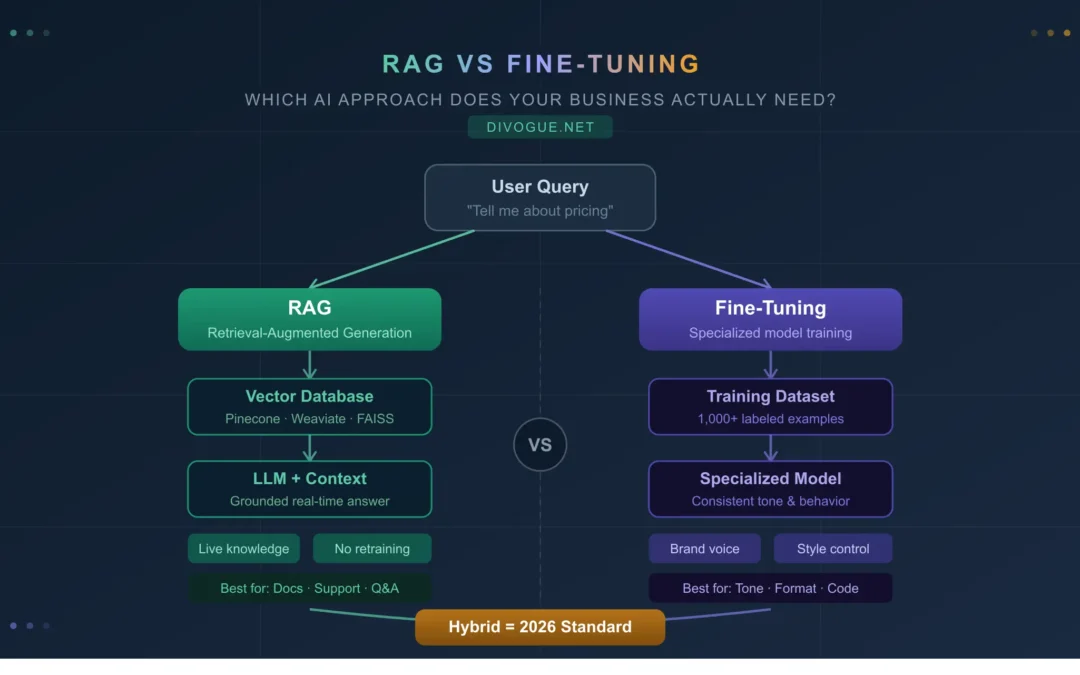
RAG is a technique where an AI model pulls relevant information from an external knowledge source at the moment it generates a response. Instead of relying solely on what it learned during training, the model retrieves current, context-specific data in real time.
Think of RAG like giving your AI a search engine. Before it answers, it looks up the most relevant documents, policies, or product information — then generates a response grounded in that fresh context.
How RAG Works (Simply):
- User submits a query
- Query is converted into a vector embedding
- A vector database finds the most semantically similar documents
- Those documents are passed as context to the LLM
- The LLM generates a response grounded in retrieved content
RAG Is Best For:
- Customer support chatbots — answering questions from live product docs
- Enterprise knowledge management — internal wikis, HR policies, SOPs
- Legal and compliance assistants — accessing up-to-date regulations
- Medical literature search — referencing current clinical guidelines
- E-commerce — real-time inventory, pricing, and product Q&A
RAG Tools & Frameworks (2026):
- LangChain — most popular RAG pipeline framework
- LlamaIndex — strong for structured/unstructured document RAG
- Pinecone, Weaviate, FAISS — vector databases for semantic search
- OpenAI Embeddings, Cohere — embedding model options
What Is Fine-Tuning?
Fine-tuning means taking a pre-trained large language model and training it further on your own curated dataset to specialize its behavior, tone, and reasoning patterns.
Think of fine-tuning like sending your AI to specialized school. It internalizes your brand’s voice, your domain’s terminology, and your preferred response formats — so it behaves consistently, every time.
Fine-Tuning Is Best For:
- Brand voice consistency — ensuring all outputs match your tone
- Code generation for internal APIs — learning proprietary syntax and patterns
- Classification tasks — routing, tagging, categorization at scale
- Specialized translation — domain-specific language (medical, legal, financial)
- Format compliance — structured outputs, consistent JSON, report formats
Fine-Tuning Tools (2026):
- OpenAI Fine-Tuning API — most accessible, supports GPT-4 variants
- Unsloth — fast, low-GPU fine-tuning for open-source models
- Hugging Face PEFT / LoRA — parameter-efficient fine-tuning
- Axolotl — flexible training framework for custom LLMs
RAG vs Fine-Tuning: Side-by-Side Comparison
| Feature | RAG | Fine-Tuning | Hybrid (Best) |
| Knowledge Updates | Real-time | Snapshot only | Real-time + Stable |
| Setup Cost | Low–Medium | High | High (worth it) |
| Training Data Needed | None | 1,000+ examples | Both |
| Factual Accuracy | Very High | High (static) | Highest |
| Style Consistency | Moderate | Very High | Very High |
| Best For | FAQs, Docs, Support | Tone, Format, Brand | Enterprise AI Products |
The Key Difference: What Problem Are You Solving?
RAG changes what the model can see right now. Fine-tuning changes how the model behaves every time. That single distinction should drive your architecture decision.
If your AI is giving wrong or outdated answers — that’s a knowledge problem. Use RAG.
If your AI is giving inconsistent, off-brand, or poorly formatted answers — that’s a behavior problem. Use Fine-Tuning.
Most businesses discover they have both problems. That’s why the hybrid approach has become the production standard in 2026.
When Should Your Business Use RAG?
RAG is the right starting point for most organizations. It offers faster time-to-value, lower upfront cost, and doesn’t require deep ML expertise to implement.
Choose RAG when:
- Your data changes frequently (daily, weekly)
- You need the AI to cite or reference specific documents
- You’re building a support bot, knowledge assistant, or Q&A tool
- You want fast iteration — update docs today, see results immediately
- You can’t or don’t want to share proprietary data with model providers
RAG also wins on traceability — critical for regulated industries like healthcare, finance, and legal, where you need to know exactly where an answer came from.
When Should Your Business Use Fine-Tuning?
Fine-tuning earns its cost when your failure mode is behavioral, not informational. If the model knows the right facts but presents them wrong — inconsistent tone, bad format, weak classification — that’s when fine-tuning pays off.
Choose Fine-Tuning when:
- You have 1,000+ high-quality labeled examples of ideal outputs
- You need consistent tone, format, or response style at scale
- You’re running high-volume, narrow tasks (e.g., SQL generation, classification)
- Prompt engineering has hit its ceiling and still isn’t good enough
- You need a smaller, cost-efficient model for a specific task
Common mistake: teams fine-tune to inject facts (new products, pricing). Don’t. Fine-tuning teaches patterns and style — not current information. That’s RAG’s job.
The 2026 Production Standard: Hybrid RAG + Fine-Tuning
The most sophisticated AI applications in 2026 no longer debate RAG vs fine-tuning. They use both — each doing the job it was built for.
How the hybrid architecture works:
- Fine-tune the base model to establish brand voice, response format, and domain reasoning
- Layer RAG on top to supply current facts, product data, and dynamic knowledge
- The fine-tuned model handles HOW to respond; RAG handles WHAT information to respond with
Enterprise customers of AI platforms like Anthropic commonly fine-tune models for company communication style and terminology, then add RAG on top for accessing current product documentation and customer data. This hybrid approach consistently outperforms either method alone in accuracy and user satisfaction benchmarks.
Decision Framework: Which Should You Start With?
Start with RAG if:
- You’re early in your AI journey
- Your knowledge base changes frequently
- You need to move quickly with lower risk
- You don’t yet have enough labeled data to fine-tune
Move to Fine-Tuning when:
- Your application has matured and requirements are stable
- Behavior consistency is a persistent problem
- You have the labeled data and compute budget
- You’ve exhausted prompt engineering improvements
Go Hybrid when:
- You’re building a production-grade, enterprise AI product
- You need both factual accuracy and behavioral reliability
- You’re processing high volumes and need cost efficiency
Pro tip: Most teams that think they need fine-tuning actually need better prompts first. In 2026, prompt engineering — with few-shot examples, chain-of-thought, and structured system prompts — handles more than most people realize.
Real-World Use Cases
RAG in Action:
- A legal tech company built a compliance assistant that retrieves from 10,000+ regulations, updated weekly — no retraining required
- A healthcare platform deployed a clinical Q&A bot that pulls from the latest medical literature in real time
- A SaaS company replaced its outdated help documentation with a RAG-powered support bot, cutting support tickets by 40%
Fine-Tuning in Action:
- A fintech startup fine-tuned a model on 5,000 analyst reports to generate on-brand investment summaries with 97% format compliance
- An e-commerce brand fine-tuned for product description generation, cutting copywriting time by 80% while maintaining consistent brand voice
Hybrid in Action:
- An e-commerce platform fine-tuned for brand voice, layered RAG for real-time inventory and pricing — achieving 60% lower inference cost than pure RAG at 50M queries/month
What This Means for Hiring AI Engineers
Choosing the right AI approach is only half the battle. Executing it requires engineers who genuinely understand RAG architecture, embedding models, vector databases, fine-tuning pipelines, and LLM evaluation — not just API wrappers.
The demand for engineers who can build and maintain production-grade RAG and fine-tuning systems has surged in 2026. These skills are scarce, and the wrong hire can set your AI roadmap back by quarters.
At Divogue, we specialize in connecting businesses with pre-vetted AI engineers who have hands-on experience in exactly these systems — RAG pipelines, LLM fine-tuning, AWS infrastructure, and hybrid AI architectures.
Need a RAG specialist or LLM engineer? Divogue’s vetted AI talent network can match you with the right engineer in days, not months. Visit divogue.net to get started.
Final Verdict: RAG, Fine-Tuning, or Both?
There is no universal answer — but there is a clear decision path:
- If your challenge is outdated or missing information: use RAG
- If your challenge is inconsistent behavior or tone: use Fine-Tuning
- If you’re building a serious production AI product: use both
The teams that ship the best AI products in 2026 aren’t debating RAG vs fine-tuning. They’re building composable systems where each layer does its specific job — and they’re hiring engineers who know how to build both.
Frequently Asked Questions (FAQ)
Q: Is RAG better than fine-tuning for most businesses?
For most businesses starting out, yes. RAG is faster to deploy, lower cost, and easier to update. Fine-tuning becomes valuable once you have consistent behavioral requirements and labeled training data.
Q: Can I use RAG and fine-tuning together?
Absolutely — and in 2026, this is the recommended approach for production systems. Use fine-tuning for style and behavior, RAG for dynamic factual knowledge.
Q: How much does fine-tuning cost?
Costs vary by model provider and dataset size. OpenAI fine-tuning for GPT-4 class models runs from hundreds to thousands of dollars depending on data volume. Open-source fine-tuning via LoRA/PEFT can be done on smaller budgets with the right GPU setup.
Q: Do I need an AI engineer to implement RAG?
Simple RAG pipelines can be set up by developers familiar with Python and LangChain. However, production-grade RAG — with reranking, hybrid search, evaluation, and reliability at scale — requires experienced AI engineers.
Q: How do I hire a qualified RAG or fine-tuning engineer?
Look for engineers with hands-on experience building vector search pipelines, working with embedding models, and deploying LLMs in production. Divogue’s pre-vetted AI talent network specializes in exactly these profiles.
Ready to Build Your AI Stack?
Divogue connects you with pre-vetted AI engineers who specialize in RAG, LLM fine-tuning, and production AI systems.
Visit www.divogue.net | info@divogue.net | +1 (818) 693 2325