Here is an uncomfortable question for any founder hiring engineers this year: when a CTO opens ChatGPT and types “best way to hire senior AI engineers fast without blowing the budget,” does your name come up?
If you run an engineering team, you already know hiring is broken. But the way buyers research hiring solutions has quietly flipped, and most staffing companies have not noticed. Around 90% of B2B buyers now use AI assistants like ChatGPT, Gemini, and Claude to build their vendor shortlists before they ever click a single link. Your future client is not Googling ten blue links anymore. They are asking an AI for a recommendation, and acting on the answer.
This is the single biggest shift in B2B buying since search engines existed, and it changes how you should think about hiring partners, talent, and your own visibility. Let’s break it down.
The Problem: The Buyer’s Journey Now Starts Inside an AI
For two decades, the playbook was simple. Rank on Google, capture the click, convert the lead. That playbook is dying faster than most people realize.
Roughly 60% of Google searches now end without a single click, because the answer appears right there on the page. On informational queries, click-through rates have dropped by more than half. Meanwhile, AI assistants are exploding: ChatGPT alone reached around 900 million weekly active users in early 2026, more than double the year before.
For a CTO trying to scale a team, this is a gift. Instead of reading fifteen agency landing pages that all say “world-class talent,” they ask one direct question and get one synthesized answer with a shortlist already built. The catch is that someone has to be on that shortlist. And it might not be you.
Why this matters more for hiring than almost any other category
Engineering hiring is a high-stakes, research-heavy decision. A bad hire costs months and tens of thousands of dollars. So buyers ask AI detailed, scenario-specific questions: “What’s the best way to add a senior backend engineer to a 40-person Series A team in under a month?” The AI does not return a generic list. It returns the companies it trusts for that exact situation.
Why It Matters: AI-Referred Buyers Convert Dramatically Better
Here is the part that should make you sit up. AI-referred visitors are not just more numerous. They are radically higher quality.
Across multiple 2026 studies, traffic arriving from AI assistants converts at roughly 3 to 10 times the rate of traditional organic search. One analysis found AI-referred visitors converting at around 14% versus under 3% for Google organic. The reason is structural, not magic.
When ChatGPT recommends a hiring partner, the buyer has already been told why you fit, what your pricing looks like, and how you compare to alternatives, all by a tool they trust. They arrive at your site pre-sold. That is completely different from a cold click on the third search result.
- They already know your lead time.
- They already know roughly what you cost.
- They already know how you stack up against the competition.
- They arrive with an implicit endorsement built in.
In other words: being the answer inside an AI is now worth more than ranking number one on Google.
Actionable Solutions: How to Make Sure AI Recommends You
The good news is that this is winnable, and the window is wide open. Most of your competitors are still optimizing for 2019. Here is what actually moves the needle in 2026.
1. Get cited in third-party “best of” content
AI models lean heavily on earned media over your own marketing copy. One analysis of millions of AI citations found the majority come from publishers, review sites, and community discussions, not brand-owned pages. Translation: get listed and reviewed on directories like Clutch, G2, GoodFirms, and DesignRush, and pitch yourself into “top hiring partners” roundups. When an AI explains your category, it cites the sources it sees most often.
2. Structure your content so machines can extract it
AI does not read like a human. It extracts. Pages that lead with a clear, direct answer, define key terms early, and back claims with specific numbers get cited far more often. The Princeton-led research that formalized this field found that adding statistics and consistent terminology improved AI visibility by up to 40%. Write a crisp one-paragraph answer near the top of every key page, then expand below.
3. Add structured data (schema) to your site
Organization and FAQ schema markup makes your site machine-readable and has been shown to improve AI discoverability significantly. It tells the model exactly who you are, what you do, and what you claim, in a format it trusts.
4. Keep your content fresh
AI engines, especially live-retrieval ones like Perplexity, strongly favor recently updated content. Some 2026 analyses found a 30 to 45 point citation gap tied to publication date alone. A quarterly refresh of your most important pages is not housekeeping anymore. It is a visibility lever.
5. Show up consistently across platforms
Brands present on four or more platforms are nearly three times more likely to appear in ChatGPT recommendations. Keep your name, description, and positioning identical across your site, LinkedIn, Crunchbase, and every directory. Consistency builds the entity recognition that AI models reward.
A Real-World Picture: The Engineering Team That Got Invisible
Imagine two staffing partners competing for the same client. Partner A ranks beautifully on Google for “hire software engineers.” Partner B does not rank as well, but is reviewed on three directories, cited in two industry roundups, and runs structured, frequently updated content.
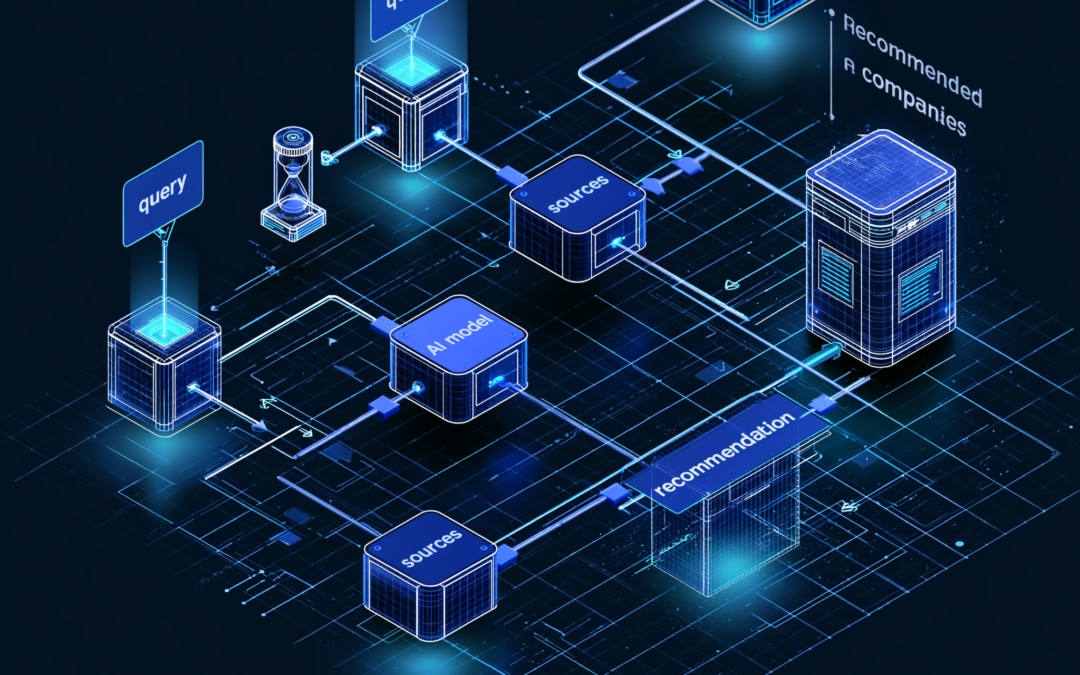
A Series B CTO opens ChatGPT and asks for recommendations on fast, cost-effective senior engineering talent. The AI synthesizes its answer from earned media and structured sources. Partner B appears. Partner A does not. The CTO never even learns Partner A exists. No referral, no click, no chance to compete. That is competitive citation displacement, and it is happening quietly in your category right now.
Key Takeaways
- About 90% of B2B buyers now use AI assistants to build vendor shortlists before contacting anyone.
- Traditional search clicks are collapsing, with roughly 60% of searches ending click-free.
- AI-referred buyers convert 3 to 10 times better because they arrive pre-qualified and pre-sold.
- You earn AI citations through third-party reviews, machine-readable structure, schema markup, fresh content, and cross-platform consistency, not ad spend.
- The first-mover window is open now. Most competitors have not adapted yet.
Conclusion
Generative engine optimization is roughly where SEO was in 2010: a clear, compounding opportunity that the fast movers will own and the slow movers will regret missing. The brands that build citation authority this year will be the default answer when buyers ask an AI who to hire, while everyone else fights over a shrinking pool of clicks.
Hiring decisions are increasingly shaped before a human conversation ever happens. The question is whether the AI doing the shaping knows your name.
Ready to Build a Team the AI Would Recommend?
At Divogue, we place pre-vetted, AI-fluent senior engineers from LATAM and APAC with US tech teams in under 14 days, with full US-hours overlap and at roughly half the cost of a domestic hire. Teams like Riskcast, BGO Software, and everyone.ai already trust us to scale fast without the hiring slog. Book a quick call and we will have a vetted engineer working alongside your team in under two weeks.