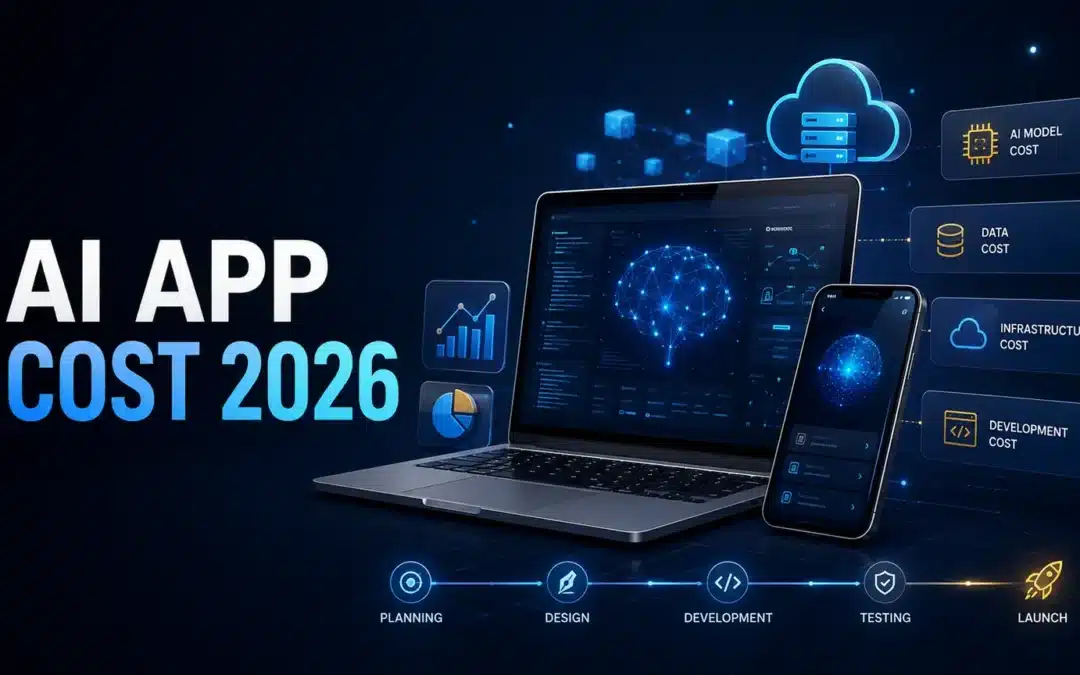
The cost to build an AI app in 2026 typically ranges from $8,000 for a focused proof of concept to $300,000 or more for an enterprise-grade platform. Most production-ready AI MVPs fall between $25,000 and $75,000, depending on the features, data, integrations, security requirements and development team.
That wide range exists because “AI app” can mean very different products. A customer-support assistant using a hosted language model is not priced like a computer-vision platform, a healthcare application with compliance requirements or an autonomous agent connected to several business systems.
This guide gives founders and technology leaders a practical 2026 pricing framework. You will see realistic cost ranges, timelines, ongoing expenses and the decisions that have the greatest effect on the budget.
AI App Development Cost at a Glance
| AI app type | Typical build cost | Typical timeline | Best for |
|---|---|---|---|
| Prototype or proof of concept | $8,000–$20,000 | 2–4 weeks | Testing technical feasibility |
| AI MVP | $25,000–$75,000 | 6–12 weeks | Validating demand with real users |
| Production AI application | $75,000–$180,000 | 3–6 months | A scalable product with integrations and monitoring |
| Enterprise AI platform | $180,000–$500,000+ | 6–12+ months | Complex workflows, compliance, agents and high scale |
These are planning ranges, not fixed quotes. A tightly scoped application can cost less, while a project with poor-quality data, many integrations or strict regulatory controls can exceed its initial tier.
What Counts as an AI App in 2026?
An AI application is software whose main value depends on a model that generates, predicts, classifies, recommends or takes action. Common examples include:
- Generative AI assistants and chatbots
- Retrieval-augmented generation (RAG) knowledge systems
- AI agents that use tools and complete multi-step tasks
- Recommendation and personalization engines
- Predictive analytics applications
- Document extraction and classification platforms
- Voice, image and video generation tools
- Computer-vision applications
The interface is only one part of the product. A reliable AI app also needs data pipelines, backend services, authentication, evaluations, security controls, monitoring and a useful user experience. In many projects, these conventional software layers consume more engineering time than connecting the model itself.
What Determines the Cost to Build an AI App?
1. Product scope and number of workflows
A single AI workflow is relatively economical. For example, an assistant that summarizes uploaded documents is easier to build than an agent that reads email, updates a CRM, creates reports and requests human approval before taking action.
Every additional workflow introduces more screens, business logic, edge cases and testing. The fastest way to control cost is to make one high-value workflow work exceptionally well before expanding the product.
2. The AI approach
Your architecture has a major effect on both the initial budget and ongoing operating cost.
| AI approach | Relative cost | Appropriate when |
|---|---|---|
| Hosted model API with prompting | Low | The app needs general generation, extraction or classification |
| RAG | Medium | Answers must use current private documents or business data |
| Fine-tuning | Medium–high | The model needs repeatable domain behavior, tone or output formats |
| Custom model training | Very high | Proprietary data or performance requirements justify owning the model |
| Agentic system | High | The AI must plan, call tools and perform multi-step actions |
Most businesses should begin with a hosted model and a focused evaluation set. Add RAG when the app needs current proprietary knowledge. Consider fine-tuning only after testing shows that prompting and retrieval cannot meet a defined quality target. Our RAG vs fine-tuning guide explains this decision in more detail.
3. Data readiness
Clean, structured and permissioned data keeps development moving. Messy PDFs, scanned documents, missing labels, duplicate records and undocumented databases create extra work before the AI can deliver dependable results.
Data-related costs may include:
- Collection and labeling
- Cleaning and deduplication
- Document parsing and optical character recognition
- Embedding and indexing
- Access controls and personally identifiable information removal
- Quality checks and evaluation datasets
For data-heavy projects, preparation can represent 15% to 30% of the initial build effort.
4. Integrations
An isolated AI demo is inexpensive. A production app may need to connect with Salesforce, HubSpot, Slack, Microsoft 365, an ERP, a payment provider or proprietary internal APIs.
Each integration needs authentication, permissions, error handling, rate-limit management, logging and testing. A simple, well-documented API may add a few days. A legacy or poorly documented system can add several weeks.
5. Accuracy and reliability requirements
A writing assistant can tolerate an occasional imperfect response. A system that supports medical, financial, insurance or legal work needs stricter grounding, evaluation, auditability and human review.
Moving from “the demo usually works” to “the product works safely under real-world conditions” requires:
- Test datasets and automated evaluations
- Hallucination and prompt-injection testing
- Model fallbacks and retry logic
- Source citations and confidence rules
- Human approval for sensitive actions
- Observability, logs and incident response
This production-hardening work is essential, and it is frequently missing from low-cost estimates.
6. Platform and user experience
A responsive web app generally costs less than separate native iOS and Android applications. Real-time voice, streaming output, collaborative workspaces, offline features, complex dashboards and multi-language support can all increase the scope.
7. Security and compliance
Enterprise buyers often require single sign-on, role-based access, encryption, audit logs, data-retention controls and isolated environments. Healthcare, financial services and other regulated sectors may also need formal compliance work and vendor reviews.
Security should be designed into the architecture rather than added just before launch. Retrofitting permissions and auditability is slower and more expensive.
AI App Cost Breakdown by Development Stage
Discovery and solution design: $3,000–$12,000
This phase converts an idea into a buildable plan. It normally includes user workflows, technical feasibility, data assessment, model selection, architecture, risk analysis and a prioritized MVP backlog.
A short discovery phase can prevent months of building features that users do not need.
UX and UI design: $4,000–$20,000
AI products need more than attractive screens. The design must show sources, uncertainty, processing states, errors and ways for users to correct or override the AI. The cost depends on the number of user roles, platforms and workflows.
AI and backend engineering: $12,000–$100,000+
This normally covers model integration, prompts, RAG pipelines, data services, application logic, APIs, authentication and third-party connections. Agentic workflows, fine-tuning and computer vision move the project toward the upper end.
Front-end or mobile development: $8,000–$60,000+
The budget depends on whether you need a responsive web interface, cross-platform mobile app or separate native apps. Admin dashboards, billing and complex collaboration features add time.
Testing, evaluation and security: $5,000–$35,000+
Traditional quality assurance checks the software. AI evaluation also tests answer quality, safety, consistency, latency and cost across representative inputs. Enterprise security reviews and penetration testing increase this allocation.
Deployment and launch: $2,000–$15,000
Deployment includes cloud configuration, continuous delivery, monitoring, alerts, backups and production readiness. High-availability or regulated environments cost more than a standard startup launch.
Cost by AI App Type
AI chatbot or internal assistant: $15,000–$60,000
A basic assistant using a hosted model sits near the bottom of the range. Private knowledge, citations, analytics, escalation rules and CRM integration push the budget upward.
RAG knowledge application: $25,000–$100,000
A production RAG system needs reliable ingestion, permissions, retrieval quality, reranking, citations and evaluation. Complex document formats or large knowledge bases require additional data engineering. See why many prototypes struggle in our guide to enterprise RAG implementation.
AI agent: $40,000–$180,000+
Agents are more expensive because they plan, use external tools and can modify business data. Tool permissions, durable state, approval steps, observability and recovery from failed actions are central to the build. Teams planning this architecture may need experienced AI agent engineers.
Predictive analytics or machine-learning app: $35,000–$150,000
The main variables are training-data quality, feature engineering, model performance, explainability and retraining requirements.
Computer-vision application: $50,000–$250,000+
Image or video applications may need data annotation, model training, GPU infrastructure, edge-device optimization and real-time processing. Accuracy requirements and camera conditions can significantly affect the budget.
Enterprise AI platform: $180,000–$500,000+
These systems may support multiple teams, models, agents and data sources. Expect advanced permissions, audit logs, evaluation infrastructure, security reviews, high availability and ongoing operations.
How Much Does an AI MVP Cost?
For most startups and small-to-midsize businesses, an AI MVP costs $25,000 to $75,000 and takes six to twelve weeks. A sensible MVP includes:
- One clearly defined user problem
- One primary AI workflow
- A web interface
- User authentication
- One or two essential integrations
- A small evaluation set
- Basic analytics, logging and monitoring
- A production deployment
An MVP should prove a business assumption, not imitate the final platform. If version one includes multiple user types, five integrations and autonomous agents, it is probably a product roadmap disguised as an MVP.
In-House vs Agency vs Offshore AI Team Cost
| Delivery model | Typical cost profile | Advantages | Trade-offs |
|---|---|---|---|
| In-house US team | Highest fixed cost | Long-term ownership and close alignment | Slow hiring and ongoing salary burden |
| US or Western European agency | $120–$250+ per hour | Mature delivery process and local access | Highest project price |
| Senior offshore/nearshore team | $25–$75 per hour | Lower cost and flexible scaling | Requires strong vetting and communication |
| Freelancers | $30–$150+ per hour | Flexible for narrow tasks | Delivery and continuity risk across a full product |
The lowest hourly rate is not always the lowest total cost. A team that lacks production AI experience may spend weeks rebuilding retrieval, evaluation or deployment work.
Divogue provides pre-vetted AI engineers from LATAM and APAC with US-hour overlap, typically at $35 per hour. For companies that already have product leadership, this can reduce the cost of adding experienced delivery capacity without committing to a permanent hire. Explore our approach to hiring AI engineers.
Ongoing AI App Costs After Launch
The build budget is only the first part of total ownership. Plan for the following monthly or annual expenses.
Model inference
Hosted AI models are generally priced by input and output tokens or by media processed. Usage varies dramatically with model choice, prompt length, response length and traffic. Current provider pricing should always be checked before launch because it changes frequently. OpenAI publishes pricing by model and token usage in its official API pricing guide.
Cloud infrastructure
A small application may spend a few hundred dollars per month on compute, databases, storage, queues, monitoring and a vector database. High traffic, GPUs, video processing or strict availability can push this into thousands or tens of thousands per month.
Maintenance and LLMOps
Budget approximately 15% to 25% of the initial development cost per year for maintenance, evaluation updates, security patches, model migrations and product improvements. Applications in fast-changing or regulated environments may require more.
Production LLM applications also need cost, latency and quality monitoring. This is where an experienced LLMOps engineer becomes valuable.
How to Reduce AI App Development Cost
Start with one measurable outcome
Define a specific result such as reducing support handling time, extracting fields from a document or increasing sales-rep productivity. A measurable target makes feature decisions easier.
Use a hosted model before training your own
Start with an API unless there is a proven technical or commercial reason to own the model. Hosted models reduce infrastructure work and let the team validate demand faster.
Build a prototype before a full MVP
A two-to-four-week proof of concept can test the riskiest assumption: model quality, data accessibility or integration feasibility. It is cheaper to change architecture before the full product exists.
Limit integrations in version one
Choose the one or two systems essential to the workflow. Add the rest after users confirm the product’s value.
Create evaluations early
A representative test set catches regressions and makes model comparisons objective. Without it, teams repeatedly debate quality and spend money fixing the same issues.
Route tasks to the right model
Do not use the largest model for every request. Smaller models can handle classification, extraction and routing, while a stronger model handles complex reasoning. Caching repeated context and shortening prompts also reduce inference cost.
Use a small senior team
A focused team with production AI experience often ships faster than a large generalist team. For many MVPs, the core group is one AI/backend engineer, one full-stack engineer, part-time product/design support and QA.
Sample Budget: A RAG-Powered Support Assistant
Consider a support assistant that answers from company documentation, cites its sources and hands difficult requests to a human.
| Workstream | Estimated budget |
|---|---|
| Discovery and architecture | $4,000–$7,000 |
| UX and interface | $4,000–$8,000 |
| Document ingestion and RAG | $8,000–$18,000 |
| Backend, authentication and admin | $7,000–$15,000 |
| Helpdesk integration | $3,000–$8,000 |
| Evaluation, QA and security | $5,000–$10,000 |
| Deployment and monitoring | $2,000–$5,000 |
| Estimated total | $33,000–$71,000 |
This example shows why a production AI application costs more than a chatbot demo. The model connection is only one component; the value comes from reliable data, workflow integration, testing and usability.
How to Estimate Your Own AI App Budget
Before asking for a quote, answer these questions:
- What user problem will the app solve?
- What measurable result defines success?
- Which AI workflow is essential for version one?
- Is the required data available, clean and legally usable?
- Which systems must the application connect to?
- What happens when the model is uncertain or wrong?
- Does an action require human approval?
- What security or compliance rules apply?
- How many users and requests do you expect?
- Who will operate and improve the product after launch?
Clear answers can narrow a very broad estimate into a credible delivery plan.
Frequently Asked Questions
How much does it cost to build an AI app in 2026?
The cost to build an AI app in 2026 usually ranges from $8,000 for a focused prototype to $300,000 or more for an enterprise platform. Most production-ready AI MVPs cost between $25,000 and $75,000.
How long does it take to develop an AI application?
A proof of concept can take two to four weeks, an AI MVP typically takes six to twelve weeks, and a full production product usually takes three to six months. Enterprise platforms can take six to twelve months or longer.
What is the cheapest way to build an AI app?
The most economical approach is to validate one workflow with a hosted model API and a simple web interface. Avoid custom model training and nonessential integrations until usage data proves they are needed.
Is an AI app more expensive than a normal app?
It can be because AI products require data preparation, model evaluation, monitoring and controls for uncertain outputs. However, using hosted models can keep a focused AI MVP within the range of conventional custom software.
Do I need to train a custom AI model?
Usually not. Most applications can start with a hosted foundation model, prompting and, when private or current knowledge is required, RAG. Custom training is justified only when measured requirements cannot be met economically with existing models.
How much does it cost to maintain an AI app?
A practical annual maintenance budget is 15% to 25% of the original build cost, plus variable model and cloud usage. High-scale or regulated systems may need a larger operations budget.
Final Takeaway
The cost to build an AI app depends less on choosing a famous model and more on product scope, data quality, integrations and the reliability standard. A focused prototype may cost $8,000 to $20,000, while a production-ready MVP generally costs $25,000 to $75,000. Complex enterprise systems can exceed $300,000.
Start with one valuable workflow, test the biggest technical risk early and invest in evaluation from the beginning. That approach produces a useful AI product faster and protects the budget from unnecessary complexity.
Planning an AI product? Divogue can help you add pre-vetted AI, RAG, LLMOps and full-stack engineers who work inside your team and overlap US hours. Book a free intro call to discuss your scope, timeline and the most cost-effective delivery approach.