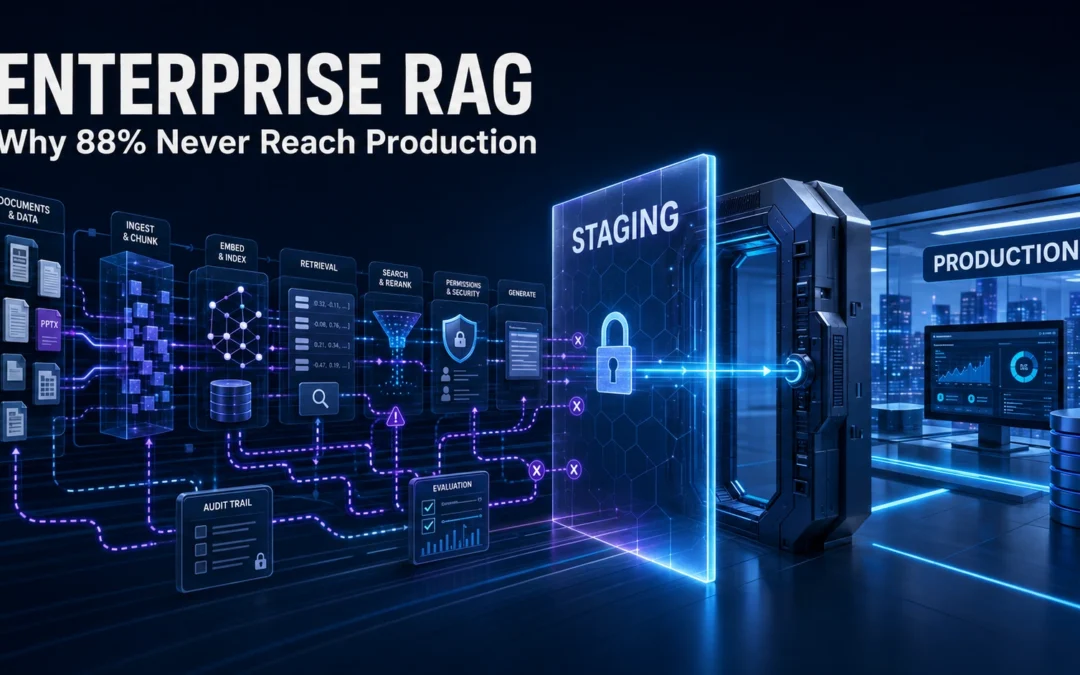
Enterprise RAG has a shipping problem. Your team builds a brilliant demo in two weeks. The executives clap. Everyone agrees it will go live next quarter. Yet six months later, it still sits in staging.
You are not imagining it. Roughly 88% of AI agent and retrieval pilots never reach production. Only 11% of enterprises run these systems live, even though 79% have already adopted them in some form. In other words, the demo is easy. Production is brutal.
So what separates that 11% from everyone else? Below, we break down why enterprise RAG projects stall, what they really cost this year, and the exact stack and 90-day plan that finally gets them shipped.
What Enterprise RAG Actually Means in 2026
Retrieval-augmented generation sounds simple. You retrieve relevant documents, then you feed them to a language model, and it answers using your data instead of guessing.
However, enterprise RAG is a completely different animal from a weekend side project. A consumer chatbot answers from one clean document set. Meanwhile, an enterprise system has to handle:
- Millions of documents spread across Confluence, SharePoint, Salesforce and legacy databases
- Row-level permissions, so a sales rep never sees an HR file
- Audit trails for every single answer the system produces
- Sub-two-second latency at hundreds of concurrent users
- Regulatory pressure from frameworks like the EU AI Act
Above all, it has to be right. A hallucinated answer in a demo is funny. The same answer inside a customer support flow costs you money and trust.
If you are still choosing between retrieval and model training, our guide on RAG vs fine-tuning covers that decision first. This article assumes you have already picked retrieval.
Why 88% of Enterprise RAG Projects Die Before Production
The failure patterns are remarkably consistent. Infrastructure gaps cause 41% of failures, governance and security barriers cause 38%, and broken ROI measurement causes 33%. Notably, “the model was not smart enough” appears nowhere on that list.
1. Retrieval quality, not model quality
Most teams obsess over which LLM to use. Instead, the real bottleneck sits upstream in retrieval. If your system pulls the wrong three paragraphs, even the best model on earth returns a confident, useless answer.
Naive chunking is usually the culprit. Splitting documents every 500 characters shreds tables, separates headings from their content, and divorces a policy from its exceptions. As a result, retrieval hands back fragments that look relevant but answer nothing.
2. Access control eats the budget
Here is the line that surprises most CTOs. The biggest cost driver in enterprise RAG is not the LLM at all. It is the access control layer, the integrations and the compliance work.
Because every document carries permissions, your retrieval layer must filter by user identity before it ranks anything. Teams routinely underestimate this. Consequently, a six-week project turns into a six-month one the moment security review begins.
3. Nobody owns evaluation
Ask a stalled team how they measure answer quality. Usually you get a shrug and a spreadsheet of twenty hand-written questions.
Meanwhile, 41% of failures trace back to unclear success criteria and 26% to drift in evaluation coverage. Without a real eval suite, you cannot prove the system improved. Therefore it never earns a green light for launch.
What Enterprise RAG Really Costs in 2026
Budget conversations go badly when nobody brings real numbers. So here is what teams actually pay this year, based on 2026 development cost benchmarks:
| Build type | Typical cost | Timeline |
|---|---|---|
| Basic prototype | $10,000 – $25,000 | 3 – 6 weeks |
| Production system with hybrid retrieval and guardrails | $25,000 – $80,000 | 8 – 16 weeks |
| Agentic or on-premises enterprise build | $60,000 – $150,000+ | 4 – 6 months |
Vector database pricing varies just as widely. For example, pgvector on your existing Postgres costs nothing extra, while managed Pinecone typically lands between $300 and $800 per month.
Still, infrastructure rarely kills the budget. Engineering time does. One senior US AI engineer costs more per year than every tool in the stack combined, which is why so many teams now compare offshore AI engineer rates before they commit.
The Enterprise RAG Stack That Actually Ships
Successful teams converge on a similar architecture. Here is what it looks like in practice.
Structure-aware chunking
First, stop splitting by character count. Instead, chunk along document structure: sections, headings and table boundaries. Then attach metadata to every chunk, including source, author, department, last-updated date and permission group.
That metadata does double duty later. It powers filtering, and it powers citations.
Hybrid search plus reranking
Second, never rely on vector similarity alone. Semantic search misses exact matches like error codes, SKUs and policy numbers. Keyword search misses paraphrases. Together, hybrid retrieval catches both.
After that, run a reranker across the top fifty results and pass only the best five to the model. Honestly, this single step lifts answer quality more than any model upgrade will.
Permission filtering at query time
Third, filter before you rank, never after. Filtering after retrieval leaks information through timing and result counts. Build identity directly into the query itself.
An evaluation suite you actually run
Finally, build a golden dataset of 200 to 300 real questions with verified answers. Then measure retrieval precision, answer faithfulness and citation accuracy on every change you ship.
Without this, you are guessing. With it, you can walk into a launch review carrying evidence.
Agentic RAG: The 2026 Upgrade Path
Standard retrieval does one lookup and answers. Agentic RAG, by contrast, lets the system plan. It decomposes a question, runs several retrievals, checks its own work and retries when confidence drops.
The gains are real for multi-step questions. However, the complexity is equally real. Agentic builds cost $60,000 to $150,000-plus precisely because orchestration, tracing and guardrails multiply the surface area.
Therefore, ship the simple version first. Add agency only where you can point to specific questions your basic pipeline keeps failing.
Who You Need on an Enterprise RAG Team
Notice that almost none of these problems are model problems. Accordingly, the hiring profile looks nothing like what most job descriptions ask for.
- Retrieval or search engineer – owns chunking, hybrid search and reranking
- Data engineer – owns connectors, sync jobs and data freshness
- LLMOps engineer – owns evaluation, tracing, cost and latency
- Security engineer, part-time – owns permission propagation and audit logging
A focused three-person team with these skills ships faster than eight generalists. If you are writing the job posts now, our breakdown of must-test technical skills for AI engineers and the LLMOps engineer role guide will save you a full hiring cycle.
A 90-Day Enterprise RAG Rollout Plan
Here is the sequence that works.
Days 1 to 30: prove retrieval, not chat
Pick one narrow use case with a clear business owner. Then build your golden question set before you build the pipeline. Measure retrieval precision only, and ignore answer polish for now.
Days 31 to 60: harden it
Next, add permission filtering, hybrid search, reranking and inline citations. Run security review in parallel rather than at the very end. Above all, do not skip the audit log.
Days 61 to 90: ship narrow, then widen
Launch to a single team of 20 to 50 users. Track deflection rate, correction rate and cost per query. Only once those numbers hold steady should you add the next data source.
In short, narrow and shipped beats broad and stalled every time. Enterprise RAG rewards teams that resist scope creep.
Key Takeaways
- 88% of pilots never reach production, and infrastructure, governance and unclear ROI cause most of it
- Retrieval quality, not model choice, decides whether an enterprise RAG system is genuinely useful
- Access control, integrations and compliance drive cost far more than LLM tokens do
- Budget $25,000 to $80,000 and 8 to 16 weeks for a real production build
- Hybrid search plus reranking delivers the biggest quality jump for the least money
- An evaluation suite is what turns a demo into an approved launch
- Ship one narrow use case in 90 days, then widen deliberately
Conclusion
Enterprise RAG is not hard because the technology is immature. It is hard because retrieval, permissions and evaluation are unglamorous engineering problems that a demo lets you skip entirely.
The teams inside that 11% did not find a better model. Instead, they staffed the boring layers properly and shipped something small. You can do exactly the same thing, and our guide to building a production-ready AI stack without a full-time team shows how lean that team can stay.
Get Your Enterprise RAG Project Out of Staging
Divogue places vetted retrieval, data and LLMOps engineers with US companies in 14 days rather than three months. If your enterprise RAG build has been stuck in staging since spring, talk to our team and we will scope the exact people you need. Alternatively, browse our LLMOps engineer hiring page to see who is available right now.